Gold IRAs come with two sets of jargon: retirement account terms and bullion terms. This glossary explains the ones you'll meet most, in plain English, with a note on why each matters when you're opening or running a gold IRA.
Terms are grouped by topic. Each links to a deeper guide where we have one.
Account Terms
Self-directed IRA: An IRA whose custodian allows alternative assets like physical metals. Every gold IRA is one. See our self-directed IRA guide.
Gold IRA / precious metals IRA: A self-directed IRA that holds IRS-eligible gold, silver, platinum or palladium.
Traditional IRA: Funded with pre-tax or deductible money. Withdrawals are taxed as income.
Roth IRA: Funded with after-tax money. Qualified withdrawals are tax-free. See our Roth gold IRA guide.
SEP and SIMPLE IRA: Employer-sponsored IRAs for small businesses and the self-employed. Both can roll into a gold IRA, with a two-year wait for SIMPLE IRAs.
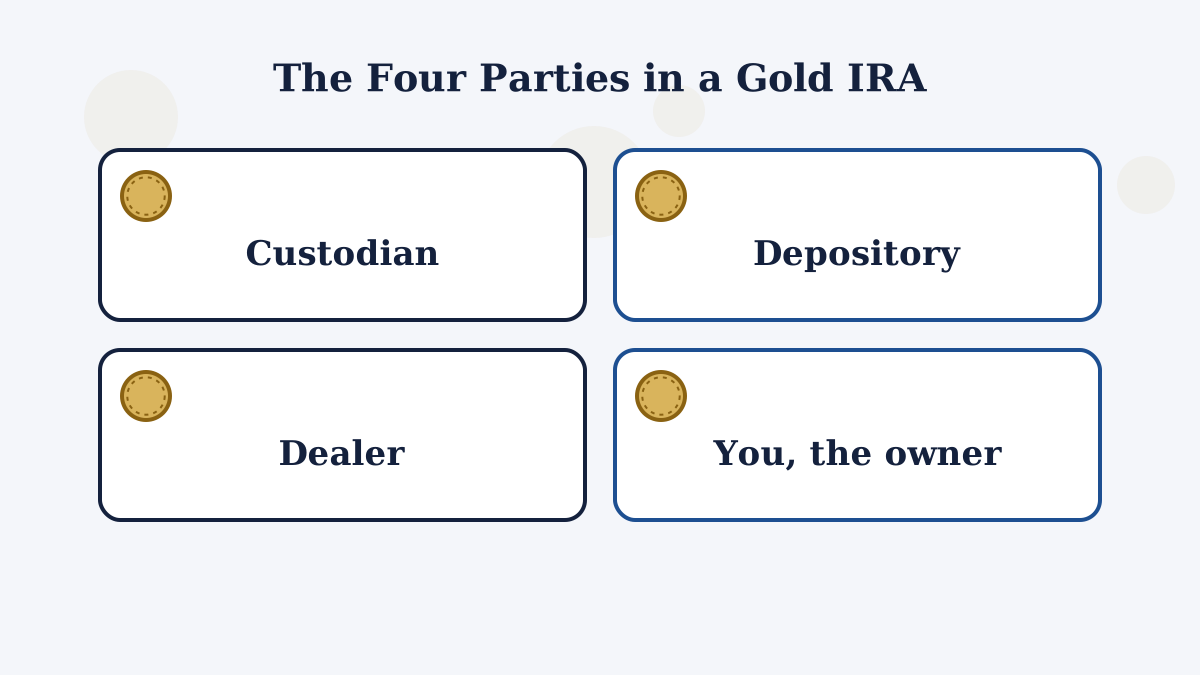
Custodian (trustee): The bank or trust company that holds your IRA, processes purchases and sales, and reports to the IRS. It doesn't give investment advice.
Depository: An approved vault that stores your IRA's metal and insures it.
Dealer: The company that sells you the metal and usually offers to buy it back. Gold IRA companies are dealers that also coordinate the account setup.
Beneficiary: The person who inherits your IRA. Named on a form with your custodian.
Funding Terms
Rollover: Moving money from a workplace plan like a 401(k) into an IRA. See our gold IRA rollover guide.
Direct rollover: The plan sends the money straight to your new custodian. No tax withholding.
Indirect (60-day) rollover: You receive the money and must deposit it within 60 days. Plans usually withhold 20% for taxes. See our 60-day rule guide.
Transfer (trustee-to-trustee): Moving money between IRAs custodian to custodian. Not reported as a distribution and not limited.
One-rollover-per-year rule: You can do only one indirect IRA-to-IRA rollover in any 12-month period. Direct transfers don't count.
Contribution limit: The most you can add to all IRAs each year: $7,500 in 2026, or $8,600 at 50 and older.
In-service rollover: Moving money from a current employer's plan while still working, if the plan allows.
Metal and Pricing Terms
Spot price: The current market price for one troy ounce for immediate delivery.
Premium: The amount above spot a dealer charges. Covers minting, distribution and profit. See our premiums over spot guide.
Spread (buy-sell spread): The gap between what a dealer sells for and what it buys back for. Your real round-trip cost.
Markup: Another term for the premium, often used for higher-margin products.
Buyback: A dealer's offer to repurchase metal it sold. Terms vary; ask what it would pay today.
Troy ounce: The standard precious metals unit, about 31.1 grams.
Fineness (purity): The share of pure metal, shown as a decimal like .9999 or a percentage.
Bullion: Bars, coins and rounds valued mainly for their metal content.
Numismatic coin: A coin valued for rarity, age or condition, often with a high markup. Usually not IRA-eligible. See our numismatic vs. bullion guide.
Proof coin: A specially struck coin with a mirror finish. Some, like Gold and Silver Eagle proofs, are IRA-eligible.
Round: A coin-shaped piece made by a private mint, with no face value.
Accredited refiner: A refiner approved by an exchange like COMEX or NYMEX, or meeting LBMA standards. IRA bars usually must come from one.
Eligibility and Storage Terms
IRS-eligible (IRA-approved): Metal meeting purity and source rules: gold 99.5%, silver 99.9%, platinum and palladium 99.95%, with American Eagle exceptions. See our IRA-approved gold coins guide.
Collectible: An asset IRAs generally can't hold, including most rare coins, art and gems. Buying one counts as a distribution.
Segregated storage: Your metal is stored separately and you get back the exact items you bought.
Commingled (non-segregated) storage: Your metal is pooled with others of the same type, and you get back equivalent items. Usually cheaper. See our storage comparison.
Home storage: Keeping IRA metal at home. Generally treated as a distribution. See our home storage guide.
Withdrawal and Tax Terms
Distribution: Any money or metal taken out of an IRA.
In-kind distribution: Taking metal itself out of the IRA instead of cash. Taxed on its value from a traditional IRA. See our physical delivery guide.
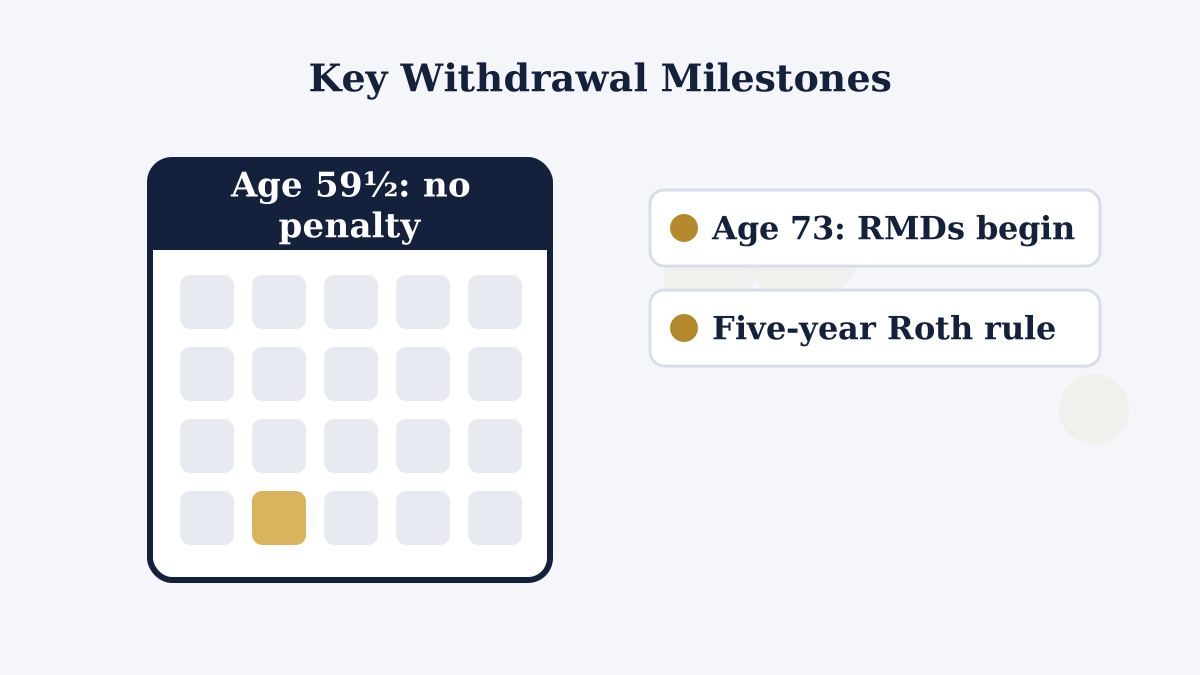
Early withdrawal penalty: A 10% additional tax on most distributions before 59½.
Required minimum distribution (RMD): The minimum traditional IRA owners must withdraw yearly from 73. See our RMD guide.
Five-year rule: For Roth IRAs, earnings are tax-free only after the account has been open five years and you're 59½.
Prohibited transaction: Dealing between your IRA and yourself or family, such as selling them IRA metal. Can disqualify the IRA. See our prohibited transactions guide.
Form 1099-R: Reports distributions from your IRA. Form 5498: Reports contributions, rollovers and year-end value. See our tax forms guide.
Collectibles tax rate: Gains on physical gold held outside an IRA for more than a year are taxed at up to 28%. See our physical gold taxes guide.
Gold IRA Glossary FAQs
What's the difference between a custodian and a depository?
The custodian administers your IRA and reports to the IRS. The depository is the vault that physically stores the metal for your IRA.
What does spot price mean?
It's the current market price for one troy ounce of a metal for immediate delivery. Dealers sell above spot and buy back below it.
What is a troy ounce?
It's the standard unit for precious metals, about 31.1 grams, slightly heavier than a regular ounce of about 28.35 grams.
The Bottom Line
You don't need to memorize every term, but knowing the core ones protects you from costly mistakes. When a company uses a term you don't understand, ask. Our resources page links every guide on the site.