A gold IRA usually costs a few hundred dollars a year to run, plus a one-time setup fee and the dealer's markup on the metal you buy. Those yearly fees pay a custodian to administer the account and a depository to store and insure the metal.
The fee that surprises people most isn't on the fee table at all. It's the spread: the difference between gold's spot price and what you pay per coin. Below, we break down every cost, show what's typical and explain how to keep the total down.
Every Gold IRA Fee at a Glance
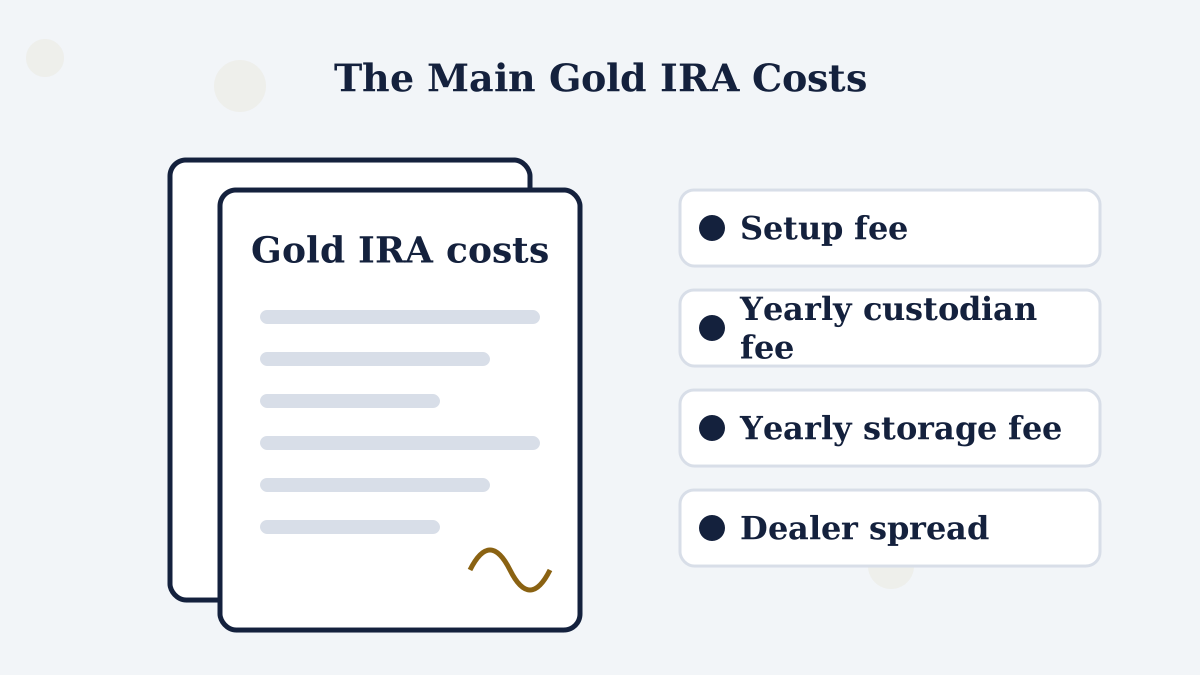
| Fee | Typical Range | How Often | Who Charges It |
|---|---|---|---|
| Account setup | $0–$300 | Once | Custodian (sometimes paid by the dealer) |
| Wire or transfer | About $25–$75 | Per transaction | Custodian |
| Custodian or maintenance | About $75–$300 | Yearly | Custodian |
| Storage and insurance | About $100–$300 | Yearly | Depository, via custodian |
| Dealer spread | A few percent to about 10% of the purchase | Per purchase | Dealer |
| In-kind distribution | Varies | When used | Custodian |
| Account closure | Varies, often $150–$250 | When used | Custodian |
Ranges vary by company and change over time. Always ask for the current schedule in writing.
Setup and Transfer Fees
The setup fee pays the custodian to open your self-directed IRA. It's usually modest, and some dealers cover it for larger accounts. A wire fee often applies when money moves in or out.
These are one-time costs, so their importance shrinks the longer you hold the account. Over ten years, a $50 setup fee is a rounding error. What matters far more are the yearly fees and the spread.
Yearly Custodian Fees
The custodian keeps your IRA compliant: it holds legal title, keeps records, sends statements and reports to the IRS. That work is billed as a yearly maintenance or administration fee.
Most precious metals custodians charge a flat fee, often between about $75 and $300 a year. Some scale the fee by account size. A flat fee is easier to plan around and gets cheaper in percentage terms as you grow.
Storage Fees: Flat vs. Percentage
Storage pays the depository to hold and insure your metal. This is where pricing models differ most.
| Account Value | Flat $160 a Year | 0.5% of Value a Year |
|---|---|---|
| $25,000 | $160 | $125 |
| $50,000 | $160 | $250 |
| $100,000 | $160 | $500 |
| $250,000 | $160 | $1,250 |
The flat example uses Noble Gold's published $160 storage fee. The 0.5% figure is an illustration of a percentage model, not any specific company. Percentage pricing can look cheaper on small accounts and become expensive on large ones.
Segregated storage, where your exact coins are kept apart, usually costs more than commingled storage. Our segregated vs. commingled guide explains when it's worth it.
The Dealer Spread: Your Biggest Cost
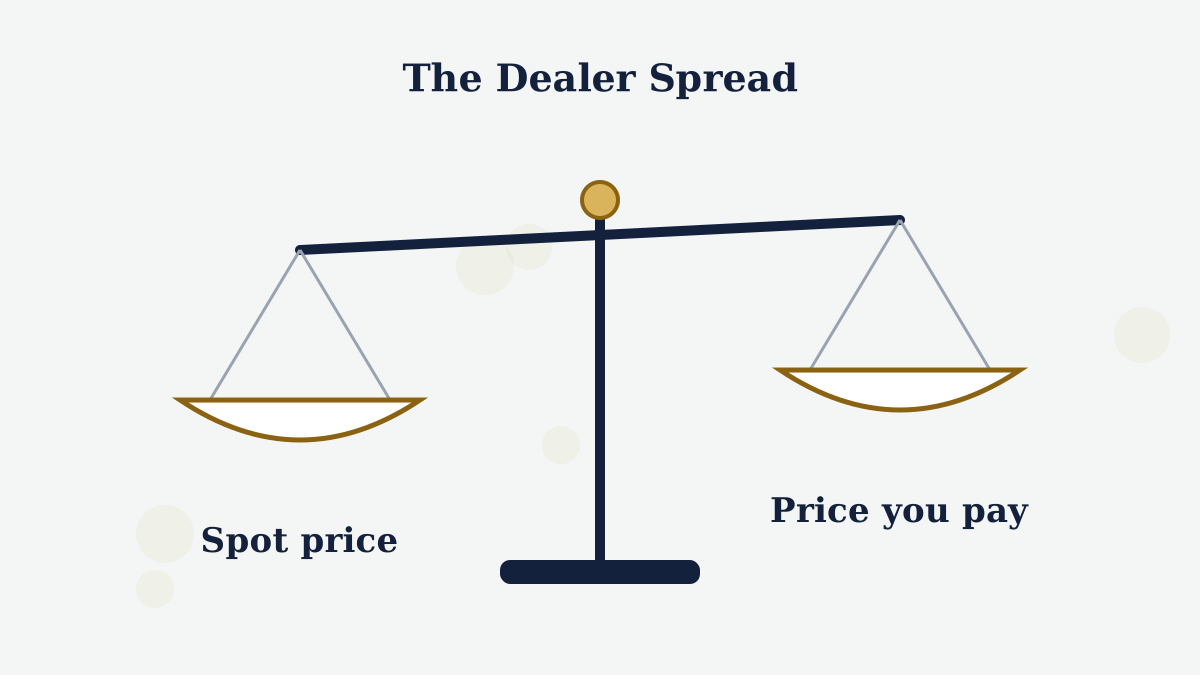
Every coin and bar sells for more than its melt value at the spot price. That premium covers minting, distribution and the dealer's margin. Figures cited across the industry range from a few percent for common bullion to around 10% or more, with collectible and proof coins often much higher.
On a $50,000 purchase, a spread of 5% costs $2,500, more than most people pay in yearly fees over a decade. That's why we tell readers to compare the price per coin before anything else. Our premiums over spot guide shows how to read a quote.
Exit Costs
Fees also apply when you leave. An in-kind distribution, where metal is shipped to you, usually carries a fee. Closing the account often does too. And when you sell metal back, the dealer's bid will sit below spot.
None of these are reasons to avoid a gold IRA. They're reasons to plan to hold for the long term and to compare buyback terms before you buy. Our selling a gold IRA guide covers the exit process.
What a Gold IRA Really Costs: An Example
Here's an illustration of ten years of costs on a $50,000 gold IRA, using Noble Gold's published fees and an assumed 5% spread at purchase. Your numbers will differ.
| Cost | Amount |
|---|---|
| Setup and wire (one-time) | $80 |
| Yearly fees ($285 × 10) | $2,850 |
| Assumed 5% spread on purchase | $2,500 |
| Total over ten years | $5,430 |
| As a share of $50,000 | About 10.9%, or about 1.1% a year |
That's in the same range as many actively managed funds, and it shows where to focus: the spread and the yearly fees both matter. Our gold IRA fee calculator lets you plug in your own numbers.
How to Keep Gold IRA Fees Down
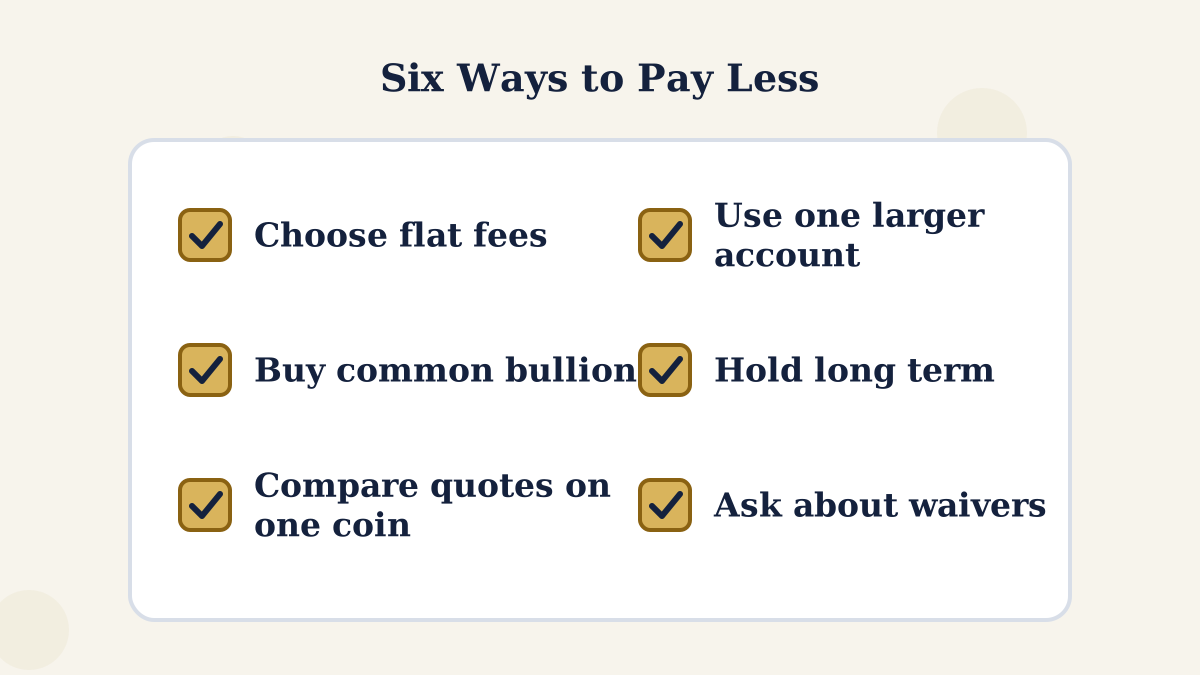
- Prefer flat fees over percentage-based storage if your balance is large.
- Buy common bullion rather than proof or collectible coins.
- Compare quotes for the same coin from two or three companies on the same day.
- Consolidate into one account instead of several small ones.
- Hold for the long term so one-time costs spread out.
- Ask about waivers on larger deposits, but don't let a waiver hide a higher spread.
How Noble Gold's Fees Compare
Noble Gold is one of the few gold IRA companies that publishes its full IRA fee table: $50 setup, $30 wire, $125 yearly maintenance, $160 yearly storage, plus listed exit fees. That's squarely in the normal range, and because it's flat, it gets cheaper in percentage terms as your account grows.
See our Noble Gold fees guide for the line-by-line breakdown and examples at different balances.
Gold IRA Fees FAQs
How much does a gold IRA cost per year?
Most gold IRAs cost a few hundred dollars a year in custodian and storage fees combined, commonly between about $175 and $400. Noble Gold, for example, publishes $125 for maintenance and $160 for storage.
What is the biggest cost of a gold IRA?
For most buyers, the dealer's spread over the spot price is the biggest single cost, because it applies to the whole purchase. Yearly fees matter more over long periods on small accounts.
Are flat fees or percentage fees better?
Flat fees usually work out cheaper as your balance grows, because they don't rise with the value of your metal. Percentage-based storage can become expensive on larger accounts.
Can I pay gold IRA fees from outside the account?
Some custodians let you pay yearly fees from a personal account instead of from IRA cash. Ask your custodian. Otherwise, many people keep a small cash balance in the IRA to cover fees.
Are there fees to close a gold IRA?
Often, yes. Many custodians charge a closure or termination fee and a fee to ship metal out in kind. Noble Gold, for example, lists $250 for closure and $75 for an in-kind distribution.
The Bottom Line
Gold IRA fees fall into two groups: account fees, which are usually a few hundred dollars a year, and the dealer spread, which can be much larger. Choose flat fees, buy common bullion, compare quotes on the same coin and plan to hold for years.