A Roth gold IRA is a self-directed Roth IRA that holds physical precious metals. You fund it with after-tax money, and qualified withdrawals are tax-free, including any rise in gold's price. It also has no required minimum distributions for the original owner.
The catches: direct contributions are limited by income and capped at $7,500 a year in 2026 ($8,600 at 50+), and moving pre-tax money into a Roth means paying tax on the conversion. Here's how it works and when it makes sense.
How a Roth Gold IRA Works
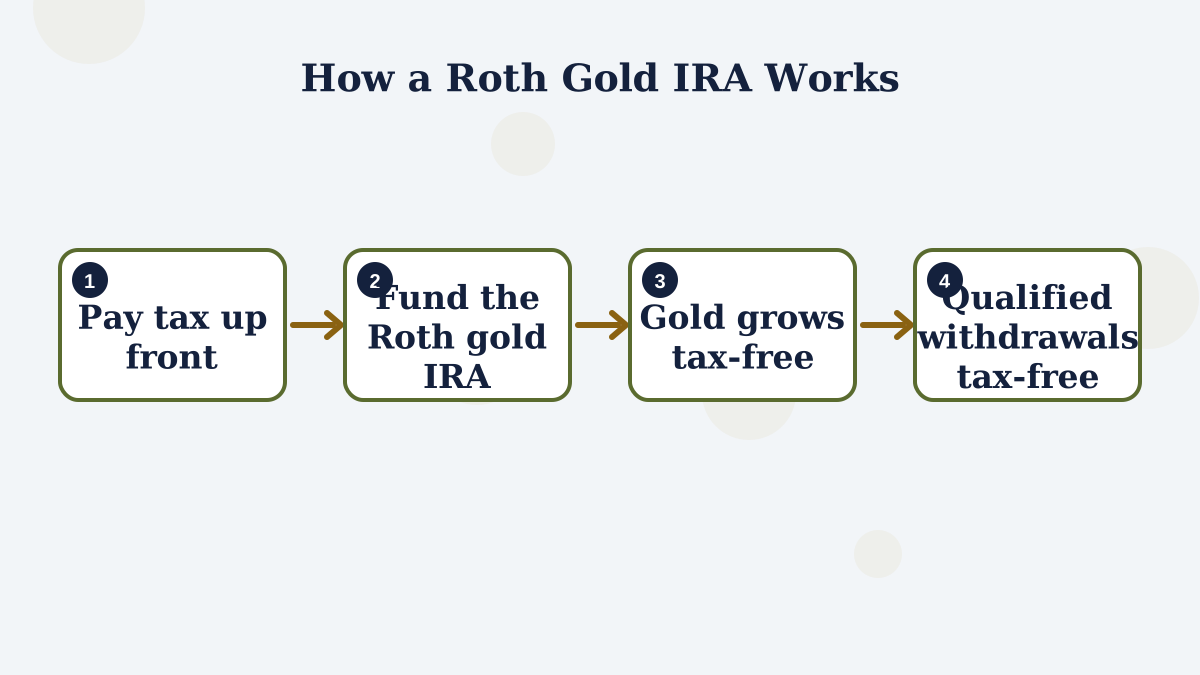
The mechanics are the same as any gold IRA: a custodian holds the account, the metal must meet IRS purity rules, and it's stored at an approved depository. What's different is the tax treatment.
| Roth Gold IRA | Traditional Gold IRA | |
|---|---|---|
| Money going in | After-tax | Pre-tax or deductible |
| Growth | Tax-free | Tax-deferred |
| Qualified withdrawals | Tax-free | Taxed as ordinary income |
| RMDs for the owner | None | From age 73 |
| Income limits to contribute | Yes | No (deduction limits may apply) |
Ways to Fund a Roth Gold IRA
- Direct contributions: up to $7,500 in 2026, or $8,600 at 50+, shared across all your IRAs, if your income is below the limit.
- Transfer from an existing Roth IRA: tax-free when done directly.
- Rollover from a Roth 401(k): tax-free if done correctly.
- Roth conversion: moving money from a traditional IRA or 401(k). The converted amount is added to your taxable income for the year.
2026 Income Limits
| Filing Status | Full Contribution If MAGI Is Below | Phase-Out Range | No Direct Contribution At |
|---|---|---|---|
| Single or head of household | $153,000 | $153,000–$168,000 | $168,000 |
| Married filing jointly | $242,000 | $242,000–$252,000 | $252,000 |
| Married filing separately (lived with spouse) | — | $0–$10,000 | $10,000 |
Income limits apply only to direct contributions. Transfers, Roth 401(k) rollovers and conversions aren't limited by income.
The Roth Conversion Question
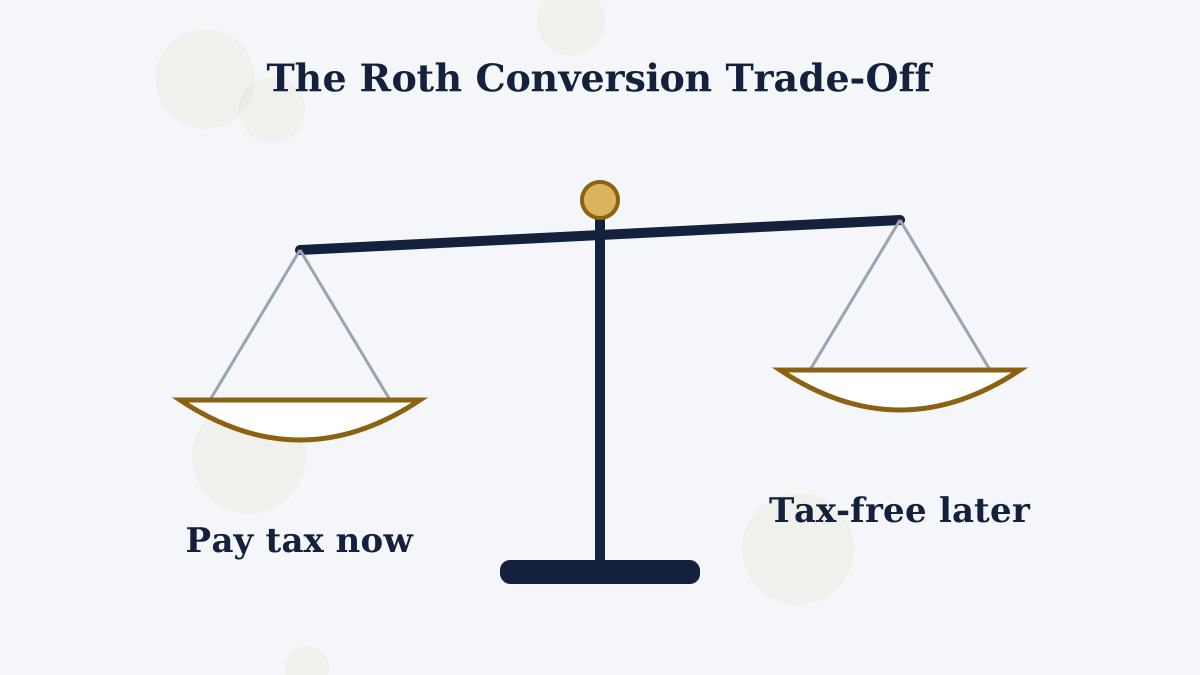
Many readers ask whether to convert a traditional IRA or 401(k) into a Roth gold IRA. A conversion means paying income tax now, at your current rate, in exchange for tax-free withdrawals later.
It can make sense if you expect a higher tax rate in retirement, have years for the money to grow, and can pay the tax from savings outside the IRA. It's usually less attractive if you're in a high bracket now or would have to use IRA money to pay the tax.
Because a large conversion can push you into a higher bracket, some people convert in stages over several years. This is a decision worth running past a tax professional.
Withdrawal Rules
Your contributions can come out at any time, tax-free and penalty-free. Earnings are tax-free once you're 59½ and your first Roth IRA has been open for at least five years. Converted amounts have their own five-year clock for the 10% penalty if you're under 59½.
You can take withdrawals as cash after selling metal, or take the metal itself as an in-kind distribution. A qualified in-kind distribution from a Roth is tax-free. See our withdrawal rules guide.
No RMDs: A Quiet Advantage
Traditional IRAs require minimum distributions from 73, which can force you to sell metal or take it out at a bad time. Roth IRAs have no RMDs for the original owner.
That makes a Roth a useful place for gold you'd like to hold for the long term or pass to heirs. Beneficiaries do have distribution rules, covered in our gold IRA beneficiaries guide.
Which Should You Choose?
Your Money Is in a Traditional 401(k) or IRA
A traditional gold IRA avoids conversion tax.
Your Money Is Already in a Roth
A Roth gold IRA keeps it tax-free.
You Expect Higher Taxes Later
A Roth conversion may be worth discussing with a tax pro.
You Want No Forced Withdrawals
Roth avoids RMDs during your lifetime.
Example: Converting $50,000
Say you move $50,000 from a traditional IRA into a Roth gold IRA. The full $50,000 is added to your taxable income for the year. If it's all taxed at an assumed 22% federal rate, that's about $11,000 in federal tax, plus any state tax.
Paying that $11,000 from savings outside the IRA keeps the full $50,000 working in the Roth. Paying it from the IRA itself shrinks the account, and if you're under 59½, the withheld amount may face a 10% penalty. These figures are illustrations only; your bracket may differ.
Costs of a Roth Gold IRA
The fees are the same as for a traditional gold IRA. Noble Gold, for example, publishes a $50 setup fee, $125 a year for maintenance and $160 a year for storage. Its IRA minimum is $20,000, which applies to Roth and traditional accounts alike.
Because direct Roth contributions are capped at $7,500 a year, reaching that minimum usually means transferring an existing Roth, rolling over a Roth 401(k) or converting.
Roth Gold IRA FAQs
Can I have a Roth gold IRA?
Yes. A self-directed Roth IRA can hold IRS-eligible precious metals. It follows all the normal Roth IRA rules for contributions and withdrawals.
Who can contribute to a Roth gold IRA in 2026?
You need earned income, and your modified adjusted gross income must be below the phase-out range, $153,000 to $168,000 for single filers and $242,000 to $252,000 for married couples filing jointly.
Can I roll my 401(k) into a Roth gold IRA?
A Roth 401(k) can roll into a Roth IRA tax-free. A traditional 401(k) can too, but that's a Roth conversion, and the converted amount is taxable income.
Do Roth gold IRAs have required minimum distributions?
No, not for the original owner. That can make a Roth useful for holding gold you don't plan to sell in retirement.
When are Roth gold IRA withdrawals tax-free?
Qualified withdrawals are tax-free once you're 59½ and the account has met the five-year rule. Your own contributions can be withdrawn at any time without tax or penalty.
The Bottom Line
A Roth gold IRA gives you tax-free growth and withdrawals on physical gold, plus freedom from RMDs. It's simplest when your money is already in a Roth. Converting pre-tax money is a tax decision first and a gold decision second.
Noble Gold offers both traditional and Roth gold IRAs. Its free kit explains the setup process for each.