Physical gold held outside an IRA is a collectible for federal tax purposes. If you hold it more than a year, gains are taxed at your ordinary rate up to a 28% maximum, higher than the 15% or 20% that applies to most long-term stock gains for many people. Gold held a year or less is taxed as ordinary income.
Your cost basis generally includes what you paid, including the premium. Some sales are reported by dealers on Form 1099-B, and state sales tax rules vary.
Federal Capital Gains on Gold
| Holding Period | Tax Treatment |
|---|---|
| One year or less | Ordinary income rates |
| More than one year | Collectibles rate: your ordinary rate, capped at 28% |
| Losses | Can offset other capital gains, with limits on ordinary income |
If your ordinary rate is below 28%, long-term collectible gains are taxed at that lower rate. If it's higher, the 28% cap applies. High earners may also owe the 3.8% net investment income tax.
Cost Basis

Your basis is generally the total you paid to acquire the gold, including the premium over spot and purchase costs like shipping. When you sell, your gain is the sale price minus your basis and selling costs.
Keep invoices showing date, product, quantity and price. Without records, proving your basis is difficult.
Dealer Reporting
When you sell certain products in certain quantities to a dealer, the dealer may be required to file Form 1099-B with the IRS. Rules depend on the specific product and amount. Some popular coins, including American Gold Eagles, generally aren't subject to that reporting.
Either way, you're responsible for reporting gains on your tax return. Dealer reporting doesn't change what you owe.
State Sales Tax
Sales tax on bullion varies widely. Many states fully exempt investment-grade gold and silver, some exempt purchases above a set amount, and a few tax them. Online purchases are generally taxed based on where they're delivered. Check your state's rules before a large purchase.
Gifting and Inheriting Gold
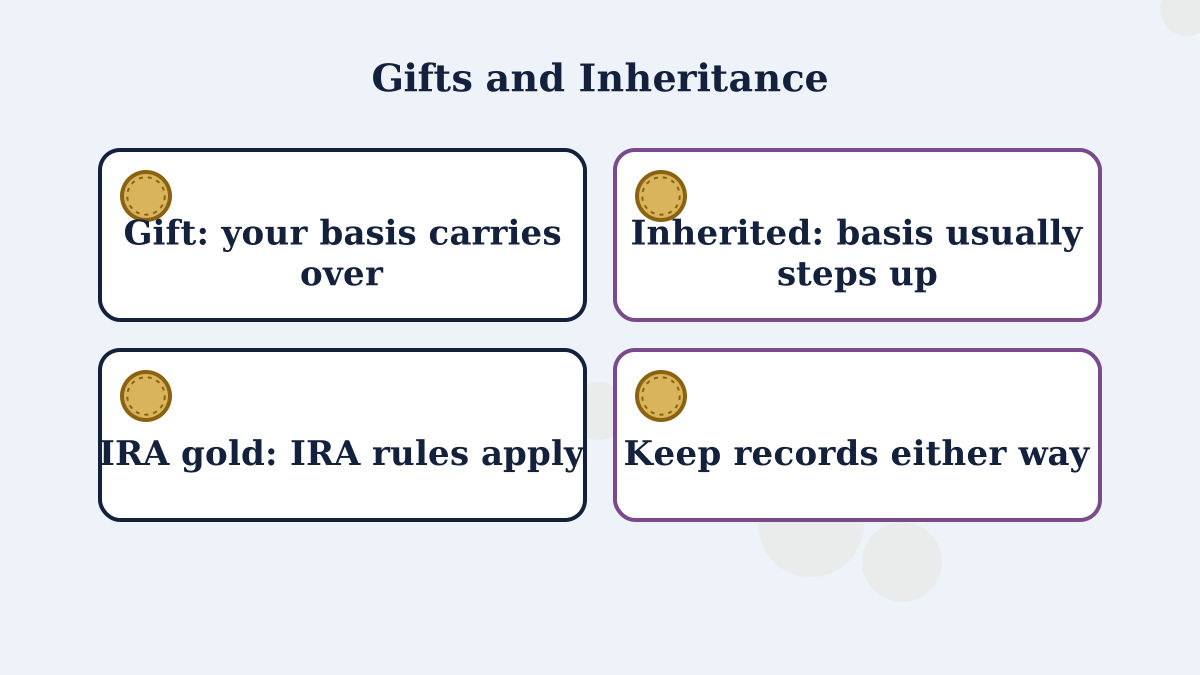
If you give gold, the recipient generally takes your basis. Large gifts may require a gift tax return. If someone inherits gold held outside a retirement account, its basis is generally its value at the owner's death, which can wipe out built-up gains.
Gold inside an inherited IRA doesn't get that step-up. It follows inherited IRA rules. See our inherited IRA guide.
Physical Gold vs. Gold in an IRA
| Physical Gold at Home | Gold in a Traditional IRA | |
|---|---|---|
| Tax on sales | Yes, collectibles rules | No, while inside |
| Tax on withdrawal | Not applicable | Ordinary income |
| Long-term rate cap | 28% | Not applicable |
| Step-up at death | Generally yes | No |
Our gold IRA vs. physical gold guide compares the trade-offs in more detail.
Tips to Stay Organized
- Keep receipts for every purchase and sale.
- Track holding periods so you know when gains become long-term.
- Sell high-basis pieces first if you're trying to limit gains.
- Talk with a tax professional before large sales.
An Example
Say you bought ten 1 oz Gold Eagles for $40,000 including premiums, and sell them three years later for $46,000. Your long-term gain is $6,000. If your ordinary tax rate is 24%, the gain is taxed at 24%. If your rate is 32%, the 28% cap applies, so you'd owe up to $1,680 in federal tax, plus any state tax and possibly the 3.8% net investment income tax.
Physical Gold Taxes FAQs
How is physical gold taxed when I sell it?
Gains on gold held over a year are taxed as collectibles at your ordinary rate, up to a maximum of 28%. Gains on gold held a year or less are taxed as ordinary income.
What is my cost basis in physical gold?
Generally what you paid, including the dealer premium and certain purchase costs. Keep your receipts.
Do gold dealers report sales to the IRS?
For certain products and quantities, dealers file Form 1099-B when you sell to them. Whether or not a form is filed, you're responsible for reporting gains.
Do I pay sales tax on gold?
It depends on your state. Many states exempt investment-grade bullion fully or above a threshold, while others tax it.
Does inherited gold get a stepped-up basis?
Gold held outside an IRA generally gets a basis equal to its value at the owner's death. Gold inside an inherited IRA follows IRA rules instead.
The Bottom Line
Physical gold outside an IRA is taxed as a collectible, with long-term gains capped at 28%. Keep good records of your basis, know your state's sales tax rules and consider whether part of your gold belongs in an IRA for tax-deferred growth.