A gold IRA is a self-directed individual retirement account that holds physical precious metals, usually gold coins and bars, instead of stocks, bonds and funds. The metal sits in an approved vault, and the account keeps the same tax treatment as any traditional or Roth IRA.
People use gold IRAs to diversify retirement savings into a physical asset that doesn't depend on any company's earnings. Most fund one by moving money from an existing 401(k) or IRA. Below, we explain how it works, the rules, what it costs and who it suits.
How a Gold IRA Works
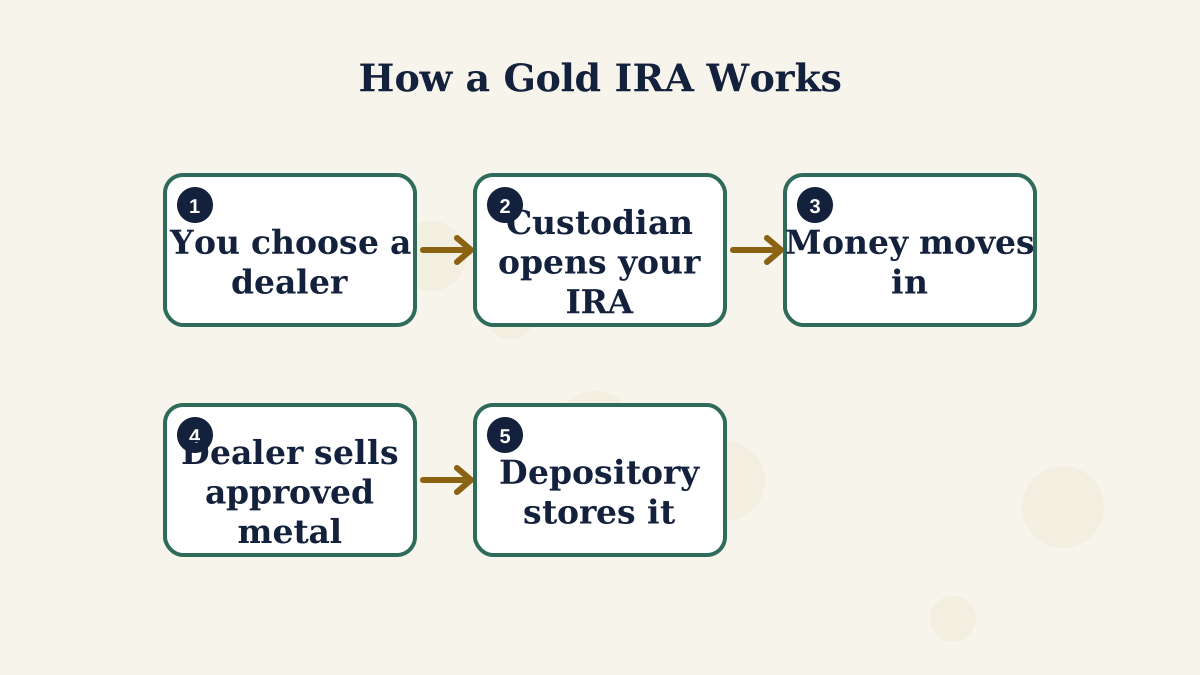
A gold IRA works like any IRA on the tax side. The difference is what it holds and who's involved. Three parties work together on your behalf:
The Dealer
A precious metals company, such as Noble Gold, that sells you the metal and coordinates the paperwork.
The Custodian
An IRS-approved institution that holds the IRA, keeps records and reports to the IRS.
The Depository
A secure, insured vault that stores the physical metal in your IRA's name.
You'll usually start with the dealer. They connect you with a custodian, help move money in from your current account and ship the metal you choose straight to the depository. You get statements from the custodian showing what you own.
Where the Money Comes From
Most gold IRAs are funded with money that's already in a retirement account. There are three ways in:
- A rollover from a 401(k), 403(b), TSP or other employer plan, usually after you've left the job.
- A transfer from an existing IRA, moved directly between custodians.
- New contributions, up to the yearly IRA limit: $7,500 in 2026, or $8,600 if you're 50 or older.
Rollovers and transfers don't count toward the contribution limit and aren't taxed when done correctly. That's why most people move a lump sum rather than building a gold IRA from yearly contributions. Our gold IRA rollover guide explains the options.
Traditional vs. Roth Gold IRAs
A gold IRA can be traditional or Roth, just like a regular IRA.
| Traditional Gold IRA | Roth Gold IRA | |
|---|---|---|
| Money going in | Pre-tax (often deductible) | After-tax |
| Growth | Tax-deferred | Tax-free |
| Withdrawals | Taxed as ordinary income | Tax-free if rules are met |
| Required minimum distributions | Yes, from age 73 | No, for the original owner |
If your money is coming from a traditional 401(k) or IRA, a traditional gold IRA is the simple choice. Moving pre-tax money into a Roth is a taxable conversion. See our Roth gold IRA guide.
The Key Rules
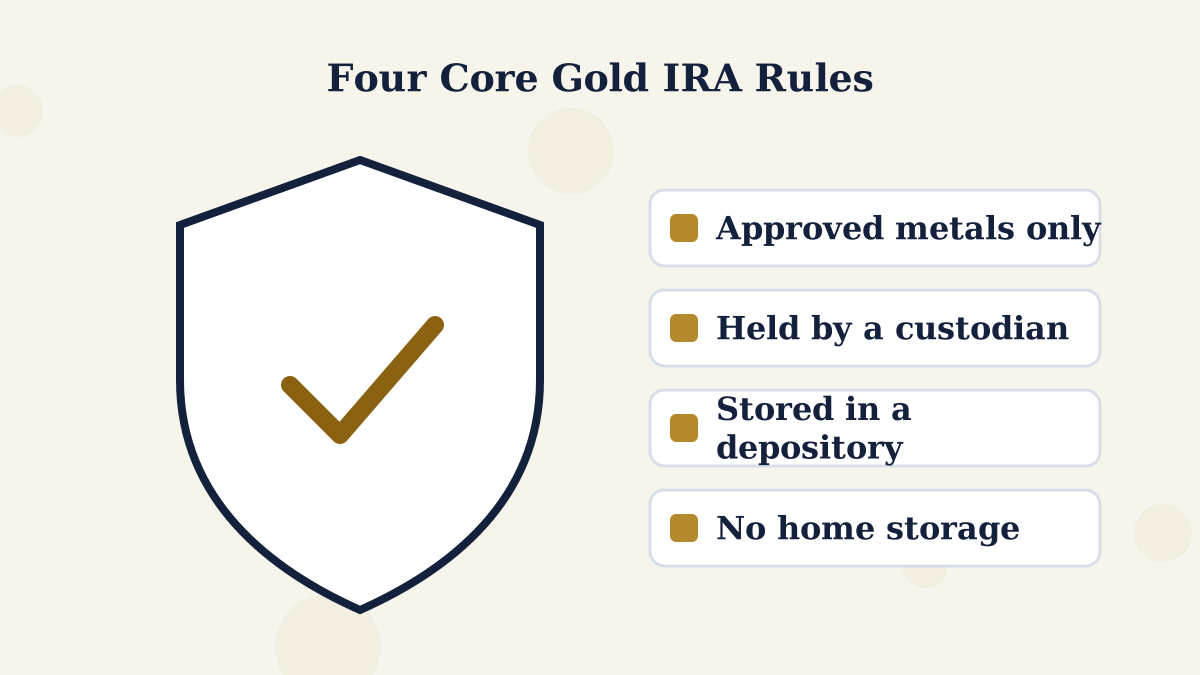
Gold IRAs are governed by the tax code's rules on collectibles. Retirement accounts generally can't hold collectibles, but the law makes an exception for bullion that meets strict purity standards.
- Purity: gold must be at least 99.5% pure, with a legal exception for the American Gold Eagle. Silver must be 99.9% pure, and platinum and palladium 99.95%.
- Custody: a qualified custodian or trustee must hold the account.
- Storage: the metal must be kept at an approved depository, not at your home.
- Distributions: the usual IRA rules apply, including penalties for early withdrawals and required minimum distributions for traditional accounts.
Breaking these rules can turn your account, or part of it, into a taxable distribution. Our gold IRA rules guide goes through each one, and our page on home storage gold IRAs explains why that popular idea is risky.
What a Gold IRA Costs
A gold IRA costs more to run than a typical brokerage IRA, because someone has to store and insure physical metal. Expect three kinds of cost:
- One-time setup costs, often around $50, plus a wire fee.
- Yearly fees for the custodian and storage, typically a few hundred dollars in total. Noble Gold, for example, publishes $125 a year for maintenance and $160 for storage.
- The dealer's spread: the gap between the spot price of gold and what you pay per coin or bar.
Flat yearly fees matter less as your balance grows, which is why most companies set minimums from $10,000 to $50,000. Our gold IRA fees guide and fee calculator help you estimate your own costs.
Pros and Cons
What We Like
- Physical metal that doesn't depend on any company's earnings
- Diversifies a stock-heavy retirement portfolio
- Keeps traditional or Roth IRA tax benefits
- Can be funded tax-free from existing retirement accounts
What to Weigh
- Higher costs than a typical IRA
- Gold pays no dividends or interest
- Prices can fall for long stretches
- You can't hold the metal yourself while it's in the IRA
For a deeper look at the trade-offs, read is a gold IRA worth it and can you lose money in a gold IRA.
Who a Gold IRA Suits
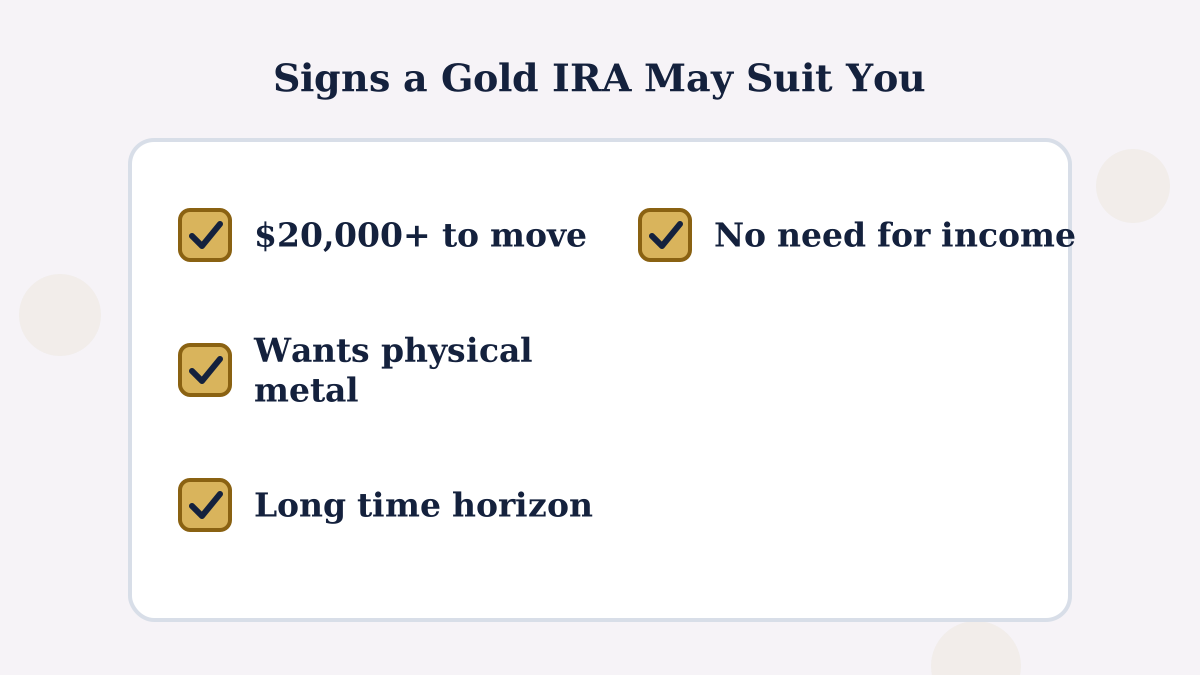
A gold IRA tends to suit people who:
- Have $20,000 or more in a 401(k) or IRA they could move.
- Want part of their savings in a physical asset outside the stock market.
- Plan to hold for many years, so one-time costs spread out.
- Are comfortable with an asset that pays no income.
It's a weaker fit if you have only a small amount to invest, need steady income from your savings, or just want exposure to the gold price. In that last case, a gold ETF in your existing IRA is cheaper. Our guide to how much gold to hold helps you size the allocation.
How to Get Started
- Decide How Much to Move
Most people keep metals to a modest share of their total savings.
- Choose a Gold IRA Company
Compare minimums, fees, storage and buyback terms. Our best gold IRA companies list is a good starting point.
- Open the Self-Directed IRA
The company connects you with a custodian, and the application is usually short.
- Move the Money Directly
Ask for a direct transfer or rollover so there's no tax withholding or 60-day deadline.
- Choose Your Metals
Pick widely traded, IRA-eligible bullion and ask for the price over spot in writing.
Our step-by-step how to open a gold IRA guide covers each stage in more detail.
What Is a Gold IRA FAQs
What is a gold IRA in simple terms?
It's a self-directed individual retirement account that holds physical precious metals, such as gold coins and bars, instead of stocks and funds. The metal is stored in an approved vault and the account keeps the usual IRA tax benefits.
Can I hold gold in a normal IRA?
Most brokerage IRAs can't hold physical gold, though they can hold gold funds. To own physical bullion in an IRA, you need a self-directed IRA with a custodian that handles precious metals.
Can I keep gold IRA metal at home?
No. IRS rules require IRA metal to be held by a custodian or approved depository. Taking it home is treated as a distribution, which can mean taxes and penalties.
How much can I put into a gold IRA in 2026?
The 2026 IRA contribution limit is $7,500, or $8,600 if you're 50 or older. Rollovers and transfers from other retirement accounts don't count toward this limit.
Is a gold IRA a good idea?
It can be a sensible way to diversify part of your retirement savings, especially if you want physical metal. It also has higher costs than a typical IRA and pays no income, so most people keep it to a modest share of their savings.
The Bottom Line
A gold IRA is simply an IRA that owns physical precious metals, stored in a vault and governed by the same tax rules as any other IRA. It's a way to add a tangible, non-stock asset to your retirement savings, at the cost of higher fees and no income.
If you're considering one, start by learning how the process works with a reputable company. We think Noble Gold's free Wealth Kit is a good place to begin.