A self-directed IRA is an IRA whose custodian allows alternative assets, such as physical precious metals, real estate or private businesses, that typical brokerage IRAs don't offer. A gold IRA is simply a self-directed IRA set up to hold IRS-eligible metals.
The tax rules are the same as any traditional or Roth IRA. What changes is who does what: you choose the assets, a specialist custodian holds them, and for metals, an approved depository stores them.
How a Self-Directed IRA Is Structured
- You decide what to buy and when to sell.
- The custodian is a bank or trust company that holds the account, processes transactions and reports to the IRS.
- The dealer sells you the metal and usually buys it back.
- The depository is an approved vault that stores the metal for your IRA.
The custodian is a record-keeper, not an adviser. It confirms that a purchase is allowed and keeps it inside the IRA, but it doesn't judge whether the price or product is good for you.
What a Self-Directed IRA Can Hold
| Asset | Allowed? | Notes |
|---|---|---|
| IRS-eligible gold, silver, platinum, palladium | Yes | Purity rules apply; depository storage required |
| Real estate | Yes | You can't use it personally |
| Private company shares, notes | Yes | Valuation and paperwork requirements |
| Collectibles (art, rare coins, gems) | No | Treated as distributions |
| Life insurance | No | Prohibited in IRAs |
Some custodians specialize in metals, others in real estate. For a gold IRA, choose a custodian experienced with precious metals. Our gold IRA custodians guide explains what to look for.
Rules That Matter Most
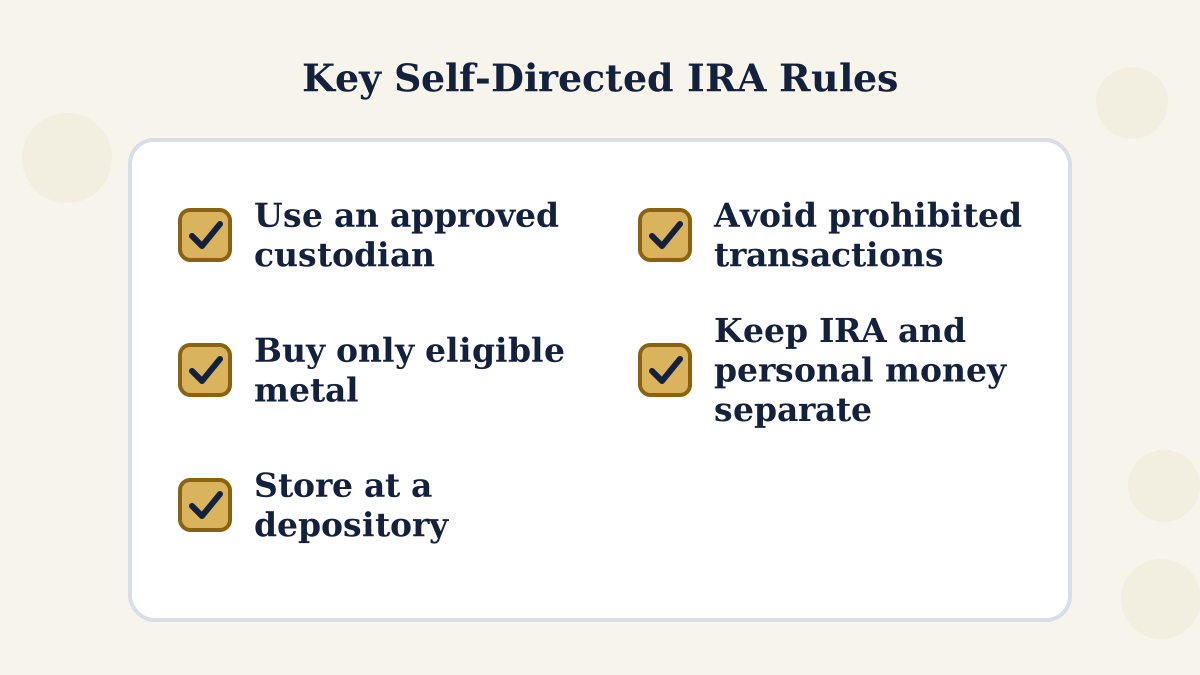
The biggest risks are breaking the rules by accident:
- Storage: IRA metal must be held by the trustee or an approved depository. Keeping it at home can count as a distribution.
- Prohibited transactions: you can't buy metal from yourself, sell IRA metal to yourself or family, or use IRA assets personally.
- Collectibles: most rare and collector coins aren't allowed, even if they contain precious metal.
See our guides to prohibited transactions and home storage.
Checkbook IRAs and Home Storage
Some promoters market "checkbook IRAs," where the IRA owns an LLC that you manage, as a way to keep gold at home. The risk is real. In McNulty v. Commissioner (2021), the Tax Court treated IRA gold kept at the owner's home through an LLC as a taxable distribution, with penalties.
For precious metals, we'd stick with depository storage through your custodian. It's the clearly compliant route.
Costs of a Self-Directed IRA
Self-directed IRAs usually cost more than brokerage IRAs because of the specialist custody and, for metals, storage. A typical gold IRA has a setup fee and yearly custodian and storage fees.
Noble Gold publishes a $50 setup fee, $125 a year for maintenance and $160 a year for storage, about $285 a year in total. See our gold IRA fees guide for how companies compare.
How to Open One for Precious Metals
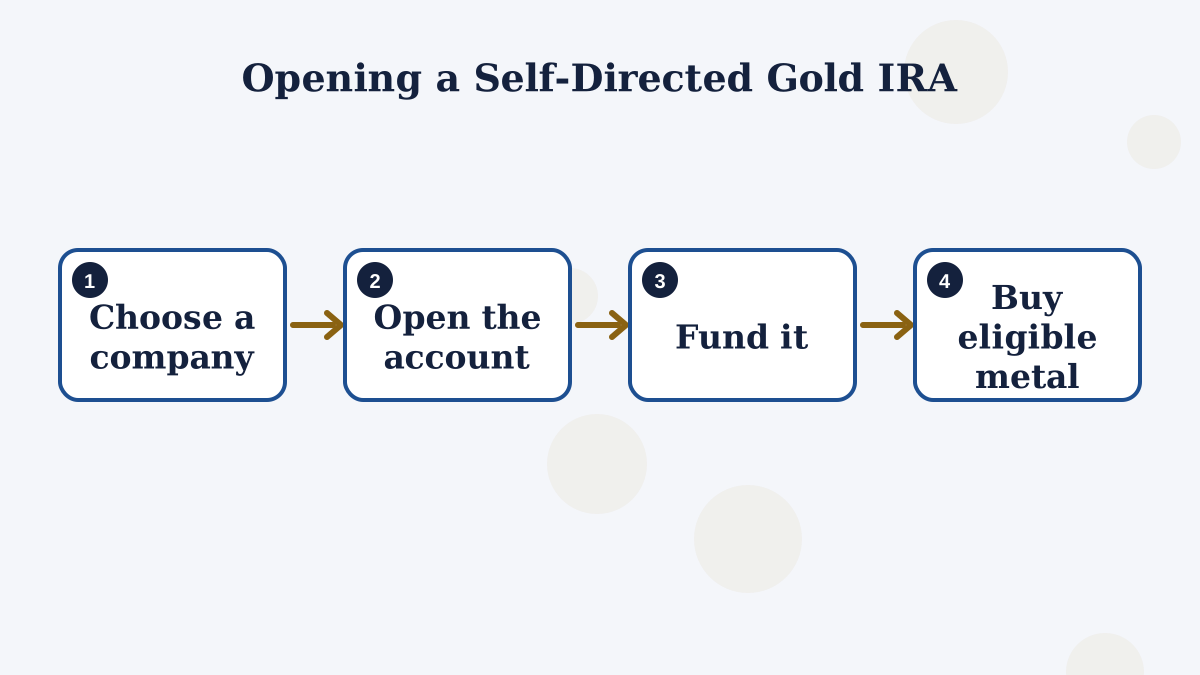
- Choose a Gold IRA Company
It typically connects you with a custodian and depository.
- Open the Self-Directed IRA
Complete the custodian's application. Match traditional to traditional, Roth to Roth.
- Fund the Account
By rollover, direct transfer or contribution.
- Buy Eligible Metal
Your custodian pays the dealer and the metal ships to the depository.
Our how to open a gold IRA guide walks through each step.
Self-Directed IRA vs. Regular IRA
| Factor | Self-Directed IRA | Regular Brokerage IRA |
|---|---|---|
| Investment choices | Wide, including physical metals and real estate | Stocks, bonds, funds, ETFs |
| Who picks investments | You | You, from the broker's menu |
| Typical costs | Setup plus yearly custodian and storage fees | Often no account fee |
| Investment vetting | None by the custodian | Products screened by the broker |
| Tax rules | Same as any IRA | Same as any IRA |
Who Should Use One
A self-directed IRA suits people who want a specific asset that regular IRAs can't hold, like physical gold, and who are comfortable doing their homework. It's usually not worth it for small balances, where flat fees take a bigger bite.
If you just want gold price exposure, a gold ETF in your current IRA may be enough. Our gold in a regular IRA guide explains that option.
Self-Directed IRA FAQs
What is a self-directed IRA?
It's an IRA held by a custodian that allows alternative assets, such as physical precious metals, real estate or private companies, that most brokerage IRAs don't offer.
Is a gold IRA a self-directed IRA?
Yes. A gold IRA is a self-directed IRA set up to hold IRS-eligible precious metals at an approved depository.
Does the custodian give investment advice?
No. Self-directed IRA custodians hold assets and handle reporting, but they don't recommend investments. You choose the assets, often with help from a dealer.
Can I use a checkbook IRA LLC to keep gold at home?
That approach carries real risk. In a 2021 Tax Court case, McNulty v. Commissioner, IRA gold kept at home through an LLC was treated as a taxable distribution. Most custodians require depository storage.
Are self-directed IRAs riskier?
The account itself follows the same tax rules, but because custodians don't vet investments, you carry more responsibility for choosing reputable companies and avoiding scams.
The Bottom Line
A self-directed IRA is what lets you own physical gold in a retirement account. It works like any IRA for taxes, but with more responsibility on you. Follow the storage and transaction rules, and work with an experienced metals company and custodian.