Traditional gold IRAs require minimum distributions starting at 73, or 75 if you were born in 1960 or later. Each year's RMD is based on the IRA's December 31 value divided by a life expectancy factor. You can meet it with cash or by taking metal in kind. Roth gold IRAs have no RMDs for the original owner.
The challenge with gold is liquidity. Planning ahead means you won't have to sell metal at a bad price just to meet a deadline.
RMD Basics
| Item | Rule |
|---|---|
| Start age | 73 (born 1951–1959); 75 (born 1960 or later) |
| First RMD deadline | April 1 of the year after you reach the start age |
| Later deadlines | December 31 each year |
| Calculation | Prior year-end value ÷ life expectancy factor |
| Roth gold IRAs | No RMDs for the original owner |
| Missed RMD penalty | 25% of the shortfall; 10% if corrected promptly |
How the Calculation Works
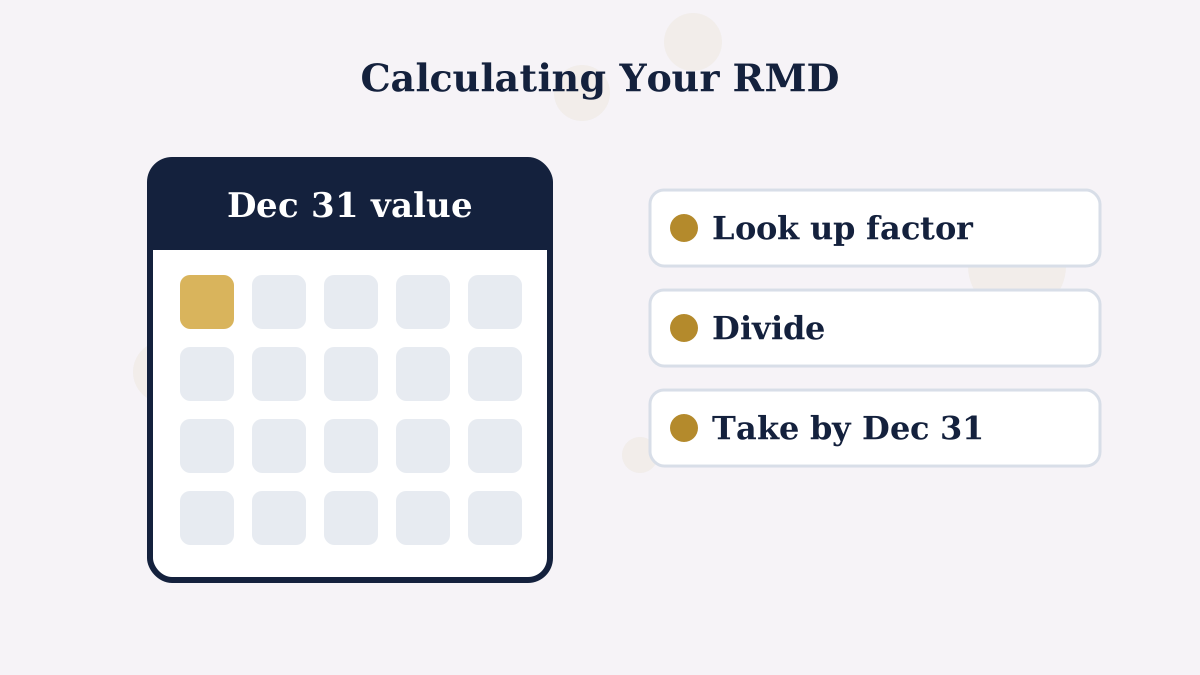
Your custodian reports your IRA's December 31 value, including metal at market prices. Divide it by the factor for your age from the IRS Uniform Lifetime Table. For example, a $100,000 gold IRA and a factor of 26.5 at age 73 give an RMD of about $3,774.
Different tables apply if your spouse is more than 10 years younger and is your sole beneficiary, or if you inherited the IRA.
Ways to Meet a Gold IRA RMD
Sell Metal for Cash
The custodian sells enough metal and sends you the cash.
Take Metal in Kind
Coins or bars are shipped to you and valued on the distribution date.
Use Cash in the IRA
Keep a cash buffer from earlier sales or contributions.
Take It From Another IRA
Combine RMDs across your IRAs and withdraw from a non-gold IRA.
Taking Metal In Kind
If you take coins as your RMD, their fair market value on the distribution date counts toward the RMD and is taxable income. Because prices move, you may need to top up with cash or take one extra coin to meet the full amount. Smaller coins make it easier to hit the number. Noble Gold lists $75 for in-kind distributions.
Combining RMDs Across IRAs
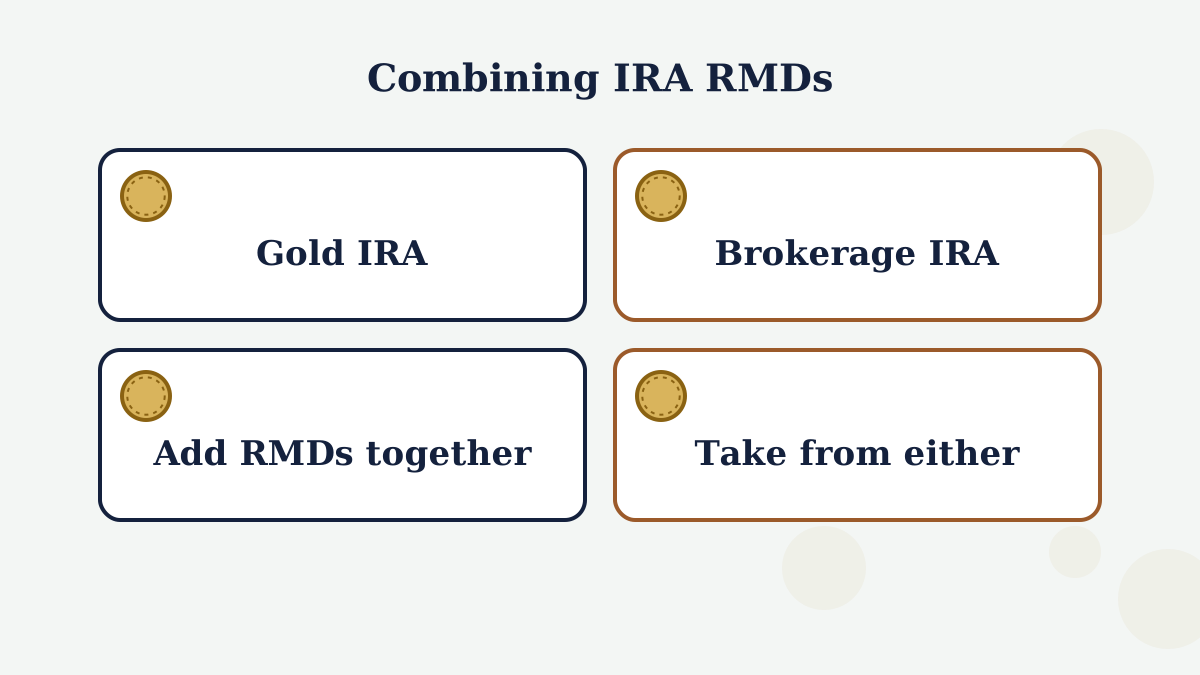
If you have several traditional IRAs, you calculate each one's RMD, add them up and can take the total from any of them. That lets many people leave their gold untouched and take RMDs from a brokerage IRA. This doesn't work across 401(k)s; each plan's RMD comes from that plan.
Avoiding the Penalty
Missing an RMD triggers a 25% excise tax on the shortfall, reduced to 10% if you correct it within the correction window. Set a reminder, ask your custodian whether it offers automatic RMD processing and allow time for metal sales or shipping before December 31.
The First-Year Double RMD
You can delay your first RMD until April 1 of the following year, but then you'll take two RMDs in that year. That can push you into a higher bracket. Many people take the first one in the year they reach RMD age instead.
Qualified Charitable Distributions
From 70½, you can give up to an inflation-adjusted annual amount directly from an IRA to charity as a qualified charitable distribution. It can count toward your RMD and isn't taxable. Ask your custodian whether it can process a QCD from a gold IRA, which may require selling metal first.
Gold IRA RMD FAQs
When do gold IRA RMDs start?
At 73 for people born from 1951 through 1959, and 75 for people born in 1960 or later. Your first RMD is due by April 1 of the year after you reach that age.
How is a gold IRA RMD calculated?
Divide the IRA's value on December 31 of the prior year by your life expectancy factor from the IRS Uniform Lifetime Table, or another table if it applies.
Can I take my RMD in gold coins?
Yes. An in-kind distribution of metal counts toward your RMD at its fair market value on the distribution date.
Can I take my gold IRA RMD from another IRA?
Yes. RMDs from multiple IRAs can be added together and taken from any one or more of your IRAs. This doesn't apply across 401(k)s.
What's the penalty for missing an RMD?
A 25% excise tax on the amount not taken, reduced to 10% if corrected within the correction window.
The Bottom Line
Traditional gold IRAs require RMDs from 73 or 75. Plan ahead with a cash buffer, smaller coins or RMDs taken from other IRAs, and never miss the deadline. Roth gold IRAs avoid RMDs during your lifetime.