A gold IRA is worth it if you want part of your retirement savings in physical metal, plan to hold for years and are moving enough money that flat fees stay small. In that case, it's a tax-advantaged way to own an asset that behaves differently from stocks and bonds.
It's not worth it if you want income, need the money soon, have only a small balance or simply want exposure to gold prices. Below, we lay out both sides and give you clear signs for each.
What a Gold IRA Does Well
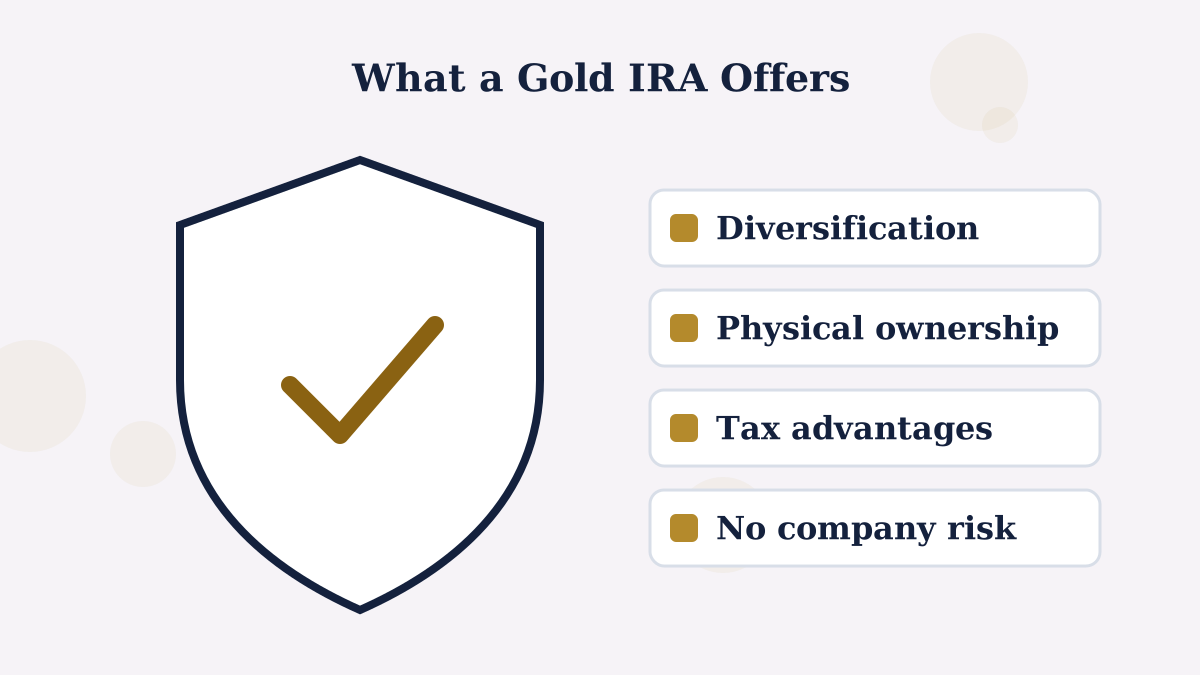
Diversification. Gold doesn't depend on a company's earnings or a government's interest payments. It has often moved differently from stocks, which is why many planners treat it as a portfolio stabilizer rather than a growth engine.
Physical ownership. In a gold IRA, your account owns specific coins or bars in a vault. That appeals to people who want an asset outside the financial system's paper promises.
Tax advantages. A traditional gold IRA grows tax-deferred, and a Roth gold IRA grows tax-free. Gold held outside an IRA is taxed as a collectible, at rates up to 28% on long-term gains.
Funding from money you already have. You can move a 401(k) or IRA into a gold IRA without tax when it's done directly, so you don't need new savings to start.
The Real Drawbacks
Higher costs. You'll pay setup, custodian and storage fees, usually a few hundred dollars a year, plus a dealer spread on every purchase. A typical index-fund IRA costs far less.
No income. Gold pays no dividends or interest. All of your return comes from price changes.
Real volatility. Gold reached an all-time high of about $5,608 an ounce in January 2026 and was trading around $4,000 in early November 2026. That's a drop of roughly 28% in under a year. Gold has also gone through multi-year slumps in the past.
Less flexibility. You can't hold IRA metal yourself, selling takes a few steps, and early withdrawals face the usual IRA penalties. Our can you lose money in a gold IRA guide covers the risks in detail.
Benefits
- Diversifies a stock-heavy retirement portfolio
- Physical metal held in your IRA's name
- Tax-deferred or tax-free growth
- Can be funded tax-free from existing accounts
Drawbacks
- Higher fees than a typical IRA
- No dividends or interest
- Prices can fall sharply and stay down
- Less convenient to buy, sell and access
Signs a Gold IRA Is Worth It for You
You Have $20,000 or More to Move
Flat yearly fees become a small share of your balance.
You Want Physical Metal
You value owning actual coins or bars, not fund shares.
Your Time Horizon Is Long
You'll hold for years, so one-time costs spread out.
You Want a Portfolio Stabilizer
You see gold as insurance, not a way to get rich.
Signs It Probably Isn't
- You have only a few thousand dollars. Flat fees of $200 to $300 a year would eat a big share.
- You need income. Dividend stocks, bonds or annuities fit better.
- You'll need the money within a few years. Gold can be down when you need to sell.
- You only want gold price exposure. A gold ETF in your existing IRA is cheaper and simpler.
- You'd be moving most of your savings. Concentrating retirement savings in one asset adds risk.
How Much Gold Makes Sense?
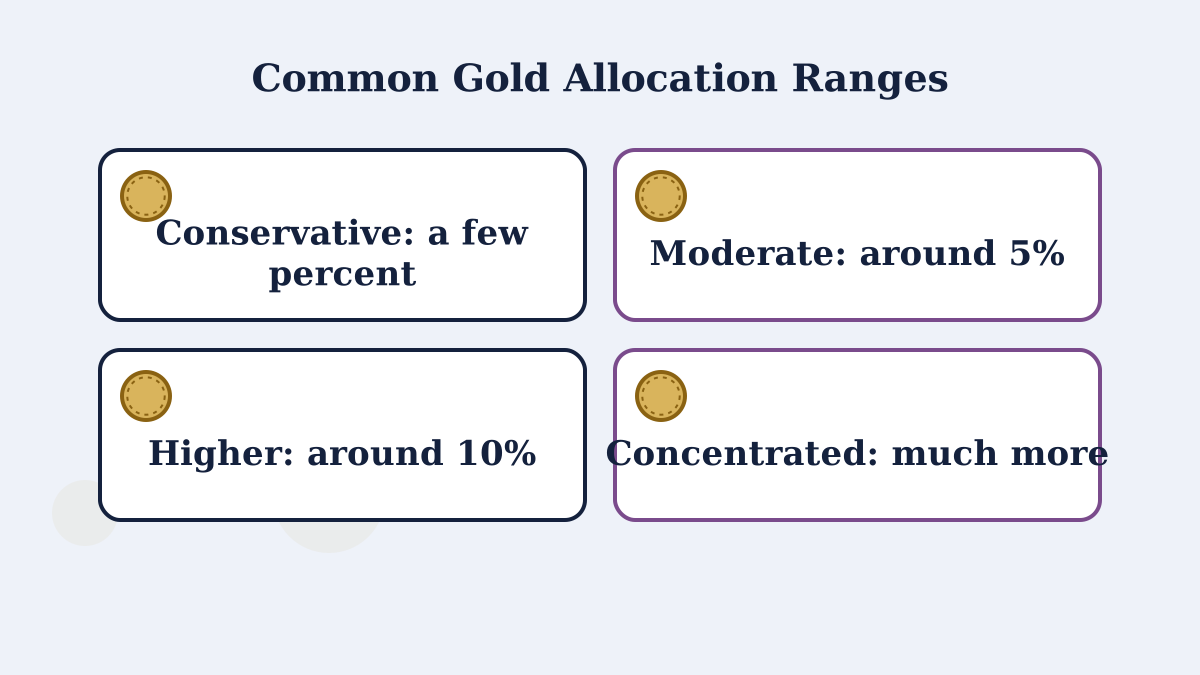
The question is rarely "gold or no gold." It's "how much." Many planners suggest keeping precious metals to a modest slice of a portfolio, often somewhere between a few percent and around 10%, depending on your age, goals and comfort with risk.
That framing changes the worth-it question. A 5% to 10% gold allocation can add diversification without making your retirement depend on gold's price. Our how much gold to hold guide walks through the reasoning.
Gold IRA vs. Other Ways to Own Gold
| Option | Own Physical Metal? | Typical Costs | Tax Treatment | Best For |
|---|---|---|---|---|
| Gold IRA | Yes, held in a vault | Setup, yearly fees, dealer spread | Tax-deferred or tax-free | Long-term retirement holding |
| Gold ETF in an IRA | No, fund shares | Fund expense ratio | Tax-deferred or tax-free | Cheap price exposure |
| Physical gold at home | Yes, in your hands | Dealer spread, storage, insurance | Collectibles rate up to 28% | Emergency access, privacy |
| Gold mining stocks | No | Brokerage costs | Depends on account | Higher risk and reward |
Many people combine two: a gold IRA for the long-term allocation and a smaller amount of coins at home. See gold IRA vs. physical gold.
If You Decide It's Worth It
Make the most of it with three habits:
- Choose Flat, Published Fees
They stay predictable as your account grows. Noble Gold, for example, publishes $125 a year for maintenance and $160 for storage.
- Buy Common Bullion
Widely traded coins and bars carry lower spreads and are easier to sell.
- Use a Direct Transfer
It avoids withholding, the 60-day deadline and rollover limits.
Our best gold IRA companies list compares the main providers on these points.
Is a Gold IRA Worth It FAQs
Is a gold IRA a good investment?
It can be a useful diversifier for part of a retirement portfolio, especially if you want physical metal. It's not a growth or income investment, has higher costs than a regular IRA and can fall in value, so most people keep it to a modest share.
What are the main downsides of a gold IRA?
Higher fees than a typical IRA, no dividends or interest, price swings that can last years, and the fact that you can't hold the metal while it's in the IRA.
Is it better to buy gold in an IRA or outside one?
In an IRA, gains are tax-deferred or tax-free, but you can't touch the metal. Outside an IRA, you can hold it, but gains are taxed at collectibles rates of up to 28%. Many people do some of both.
How much of my retirement should be in gold?
There's no single right answer. Many planners suggest keeping precious metals to a modest slice, often in the range of a few percent to around 10% of a portfolio, depending on your goals and risk tolerance.
Has gold gone down in value?
Yes, gold can fall. It reached an all-time high of about $5,608 an ounce in January 2026 and was trading near $4,000 in early November 2026, roughly 28% lower.
The Bottom Line
A gold IRA is worth it for long-term savers who want a modest share of their retirement in physical metal and have enough to move that flat fees stay small. It isn't a growth or income investment, and its price can fall, so size it sensibly.
If it fits your situation, start by understanding the process from a reputable company.