A gold IRA follows the same tax rules as any IRA, plus three extra rules about the metal itself: it has to meet IRS purity standards, a qualified custodian has to hold the account, and the metal has to be stored at an approved depository, not at home.
Get those three right, and the rest works like a normal IRA: the same contribution limits, rollover rules, withdrawal penalties and required minimum distributions. Here's each rule in plain English.
Why Special Rules Apply to Gold
Retirement accounts generally can't hold collectibles, a category in the tax code that includes coins, art and antiques. Buying a collectible in an IRA is treated as a distribution.
The law carves out an exception for certain gold, silver, platinum and palladium bullion that meets fineness standards. That exception, in section 408(m) of the tax code, is what makes gold IRAs possible. The rules below all flow from it.
Rule 1: Only Eligible Metals
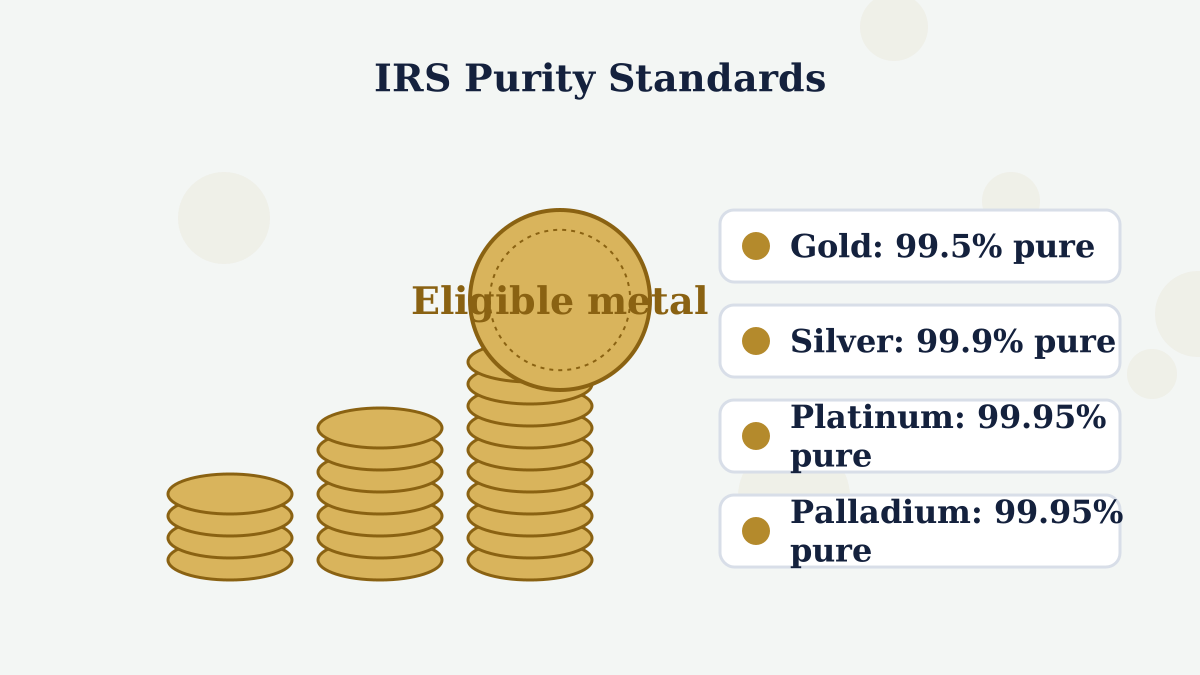
| Metal | Minimum Fineness | Notable Exception |
|---|---|---|
| Gold | 99.5% (.995) | American Gold Eagle (91.67%) is allowed by statute |
| Silver | 99.9% (.999) | American Silver Eagle is allowed |
| Platinum | 99.95% (.9995) | — |
| Palladium | 99.95% (.9995) | — |
Bars and coins also need to come from approved refiners or mints. Rare, graded and most proof coins don't qualify, even if they're made of gold, because they're valued as collectibles. Your custodian checks eligibility before the purchase.
See our guides to IRA-approved gold coins, IRA-approved silver coins and numismatic vs. bullion coins.
Rule 2: A Qualified Custodian Holds the Account
A gold IRA is a self-directed IRA, and it must be held by a qualified custodian or trustee, usually a bank or trust company that specializes in alternative assets.
The custodian keeps records, reports to the IRS (including Form 5498 for contributions and account value, and Form 1099-R for distributions), and pays for your metal from IRA funds. You never pay the dealer directly from personal money for IRA purchases. See our gold IRA custodians guide.
Rule 3: Storage at an Approved Depository
IRA metal has to be held by the custodian or at an approved depository. You can't keep it at home, in a personal safe or in your own bank safe-deposit box.
In 2021, the U.S. Tax Court ruled in McNulty v. Commissioner that a taxpayer who kept IRA-purchased coins at home had taken distributions, making them taxable. That's why we'd steer well clear of so-called "home storage" IRAs. Our home storage gold IRA guide explains the case and the risks.
Rule 4: Contribution Limits
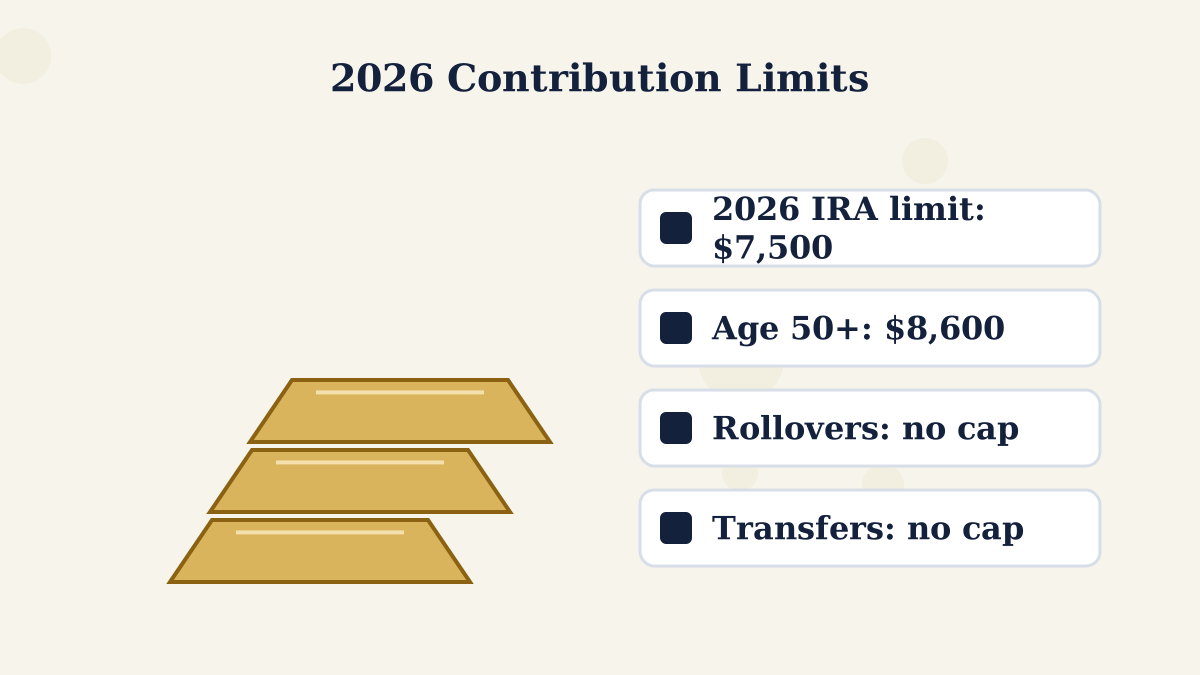
Gold IRAs share the same yearly limit as all your IRAs combined. For 2026, that's $7,500, or $8,600 if you're 50 or older. The limit applies across all your traditional and Roth IRAs together, not per account.
2026 IRA Contribution Limits
Source: IRS cost-of-living adjustments for 2026. Rollovers and transfers aren't limited.
| Item | Value |
|---|---|
| Under age 50 | $7,500 |
| Age 50 or older | $8,600 |
Rollovers and direct transfers don't count toward the limit, which is why most gold IRAs are funded with a lump sum from an existing account. See our contribution limits guide.
Rule 5: Rollovers and Transfers
Money can move into a gold IRA by direct transfer, direct rollover or indirect rollover. The rules that matter:
- Indirect rollovers must be completed within 60 days, or the money becomes a taxable distribution.
- Only one indirect IRA-to-IRA rollover is allowed in any 12-month period. Direct transfers and employer-plan rollovers don't count toward this.
- Employer plans usually withhold 20% on indirect rollovers.
Our gold IRA rollover guide and 60-day rule guide cover each one.
Rule 6: Prohibited Transactions
You and certain close family members can't use IRA assets for personal benefit. That means no personally using or displaying IRA metal, no selling your own gold to your IRA, and no borrowing against the account.
Breaking these rules can disqualify the whole IRA, turning it into a taxable distribution as of the start of that year. See gold IRA prohibited transactions.
Rule 7: Withdrawals and RMDs
Gold IRA withdrawals follow standard IRA rules:
- Before 59½: withdrawals are usually taxable, plus a 10% penalty unless an exception applies.
- Traditional IRA: withdrawals are taxed as ordinary income.
- Roth IRA: qualified withdrawals are tax-free.
- Required minimum distributions start at age 73 for traditional accounts.
You can withdraw cash (after selling metal) or take the metal itself, called an in-kind distribution. Either way, the value is reported and taxed. See our withdrawal rules and RMD guide.
Rules Checklist Before You Buy
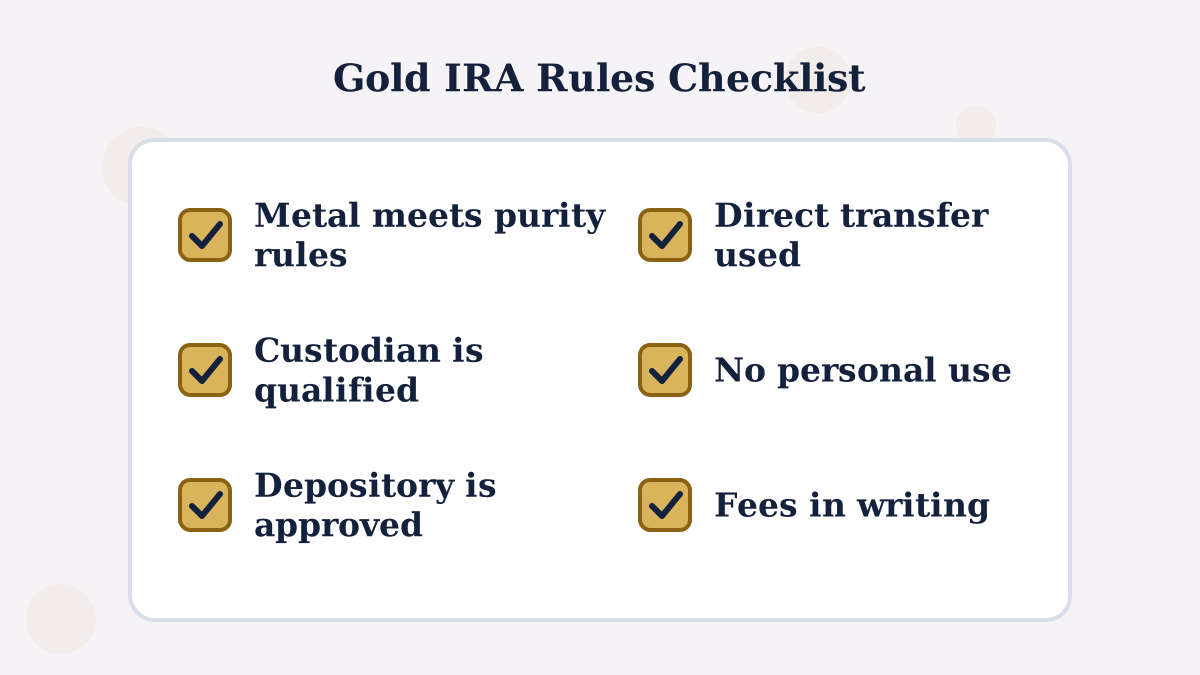
- The coin or bar meets IRS purity rules and is accepted by your custodian.
- Your custodian is a qualified IRA trustee.
- Your metal ships straight to an approved depository.
- You're moving money by direct transfer or rollover.
- You won't take possession of or personally use IRA metal.
- You have the fee schedule and price quotes in writing.
A reputable gold IRA company handles most of this for you. That's one reason we'd use an established dealer rather than doing it alone.
Gold IRA Rules FAQs
What are the main IRS rules for a gold IRA?
Only bullion that meets IRS purity standards can be held, a qualified custodian must hold the account, and the metal must be stored at an approved depository. Contribution limits, rollover rules and withdrawal rules are the same as for any IRA.
What purity does IRA gold need?
Gold must be at least 99.5% pure, with a legal exception for the American Gold Eagle. Silver must be 99.9% pure, and platinum and palladium 99.95%.
Can I store my gold IRA at home?
No. IRA metal must be held by a custodian or approved depository. The U.S. Tax Court ruled against a home-storage arrangement in 2021, treating the metal as distributed.
What is the 2026 contribution limit for a gold IRA?
$7,500, or $8,600 if you're 50 or older. Rollovers and transfers don't count toward the limit.
When do I have to take money out of a gold IRA?
Traditional gold IRAs are subject to required minimum distributions starting at age 73. Roth IRAs have no RMDs for the original owner. You can take cash or the metal itself.
The Bottom Line
Gold IRA rules come down to three extra requirements, eligible metal, a qualified custodian and approved storage, on top of the standard IRA rules everyone follows. Stay inside those lines and a gold IRA keeps all the tax benefits of any other IRA.