The premium over spot is what you pay above the metal's market price. It covers minting, distribution, the dealer's costs and profit. For common gold bullion, premiums are usually a few percent. For small coins and silver they're higher, and for collector coins they can be many times higher.
Because the premium is paid up front and can't be recovered, it's often the biggest cost in a gold IRA. The good news: you can check it with a calculator and a spot price.
How to Calculate a Premium
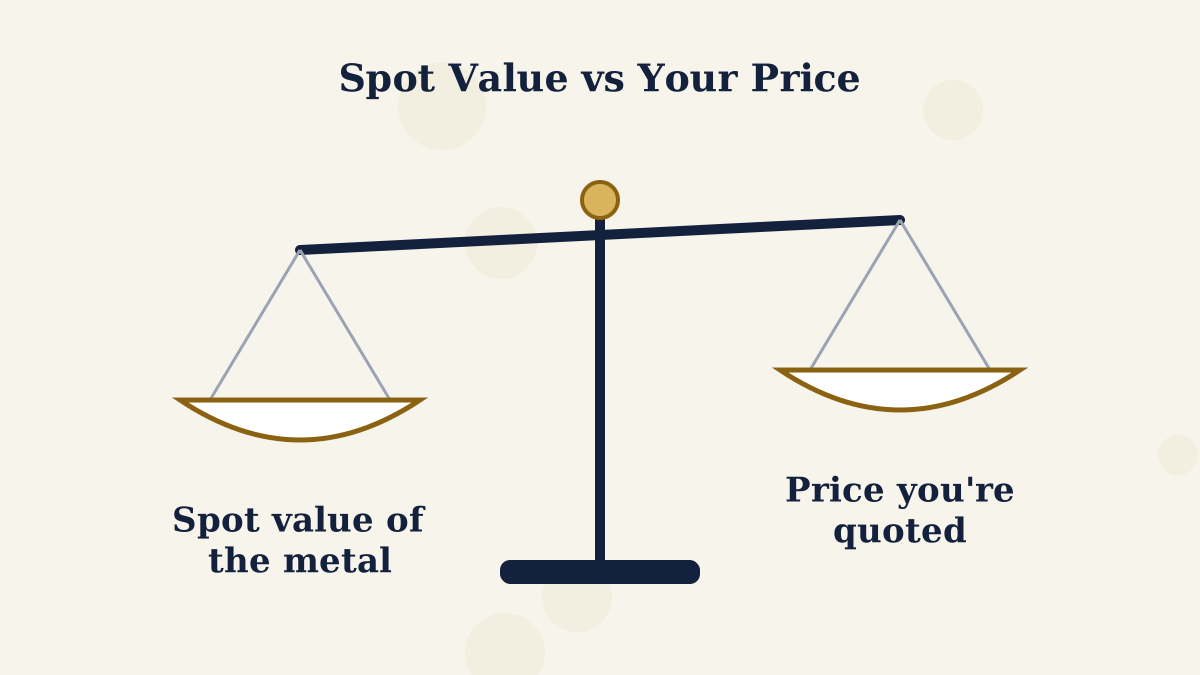
Premium % = (Price quoted − Spot value) ÷ Spot value × 100
Say spot gold is $4,000 and you're quoted $4,160 for a 1 oz coin. The premium is $160, or 4%. For a coin with less than an ounce of gold, multiply spot by the gold weight first.
Typical Premium Ranges
| Product | Typical Premium | Why |
|---|---|---|
| Large gold bars (1 kg) | About 1–2% | Costs spread over lots of metal |
| 1 oz gold bars | About 2–4% | Simple to make |
| 1 oz gold coins (Eagle, Maple Leaf, Buffalo) | About 4–8% | Minting and legal tender status |
| Fractional gold coins (1/10–1/4 oz) | Often 10–20% or more | Same costs, less gold |
| Silver bars (100 oz) | Low single digits to mid-teens | Varies with demand |
| Silver coins (Silver Eagles) | Often well above gold coin premiums | High demand, small size |
| Proof and collector coins | Often far higher | Valued as collectibles |
These are ranges seen in typical markets, not quotes. In November 2026, the lowest online dealer prices for 1 oz Gold Eagles were running around 2% to 3% over spot, below the typical range. Premiums widen when demand spikes.
Why Premiums Change
Premiums rise when demand surges faster than mints and refiners can supply products, as happened in 2020. They also differ by dealer, payment method and order size. Larger orders and bank wire payments often get lower premiums.
Premiums Inside a Gold IRA
Gold IRA companies sell metal like any dealer, so the same math applies. Some also offer promotions, which can offset part of the premium. Compare the net price per ounce after any bonus. Our gold IRA promotions guide shows how.
Some IRA dealers quote a flat price rather than a premium. Ask for spot at the time of the quote so you can calculate it yourself.
Spread: The Round-Trip Cost
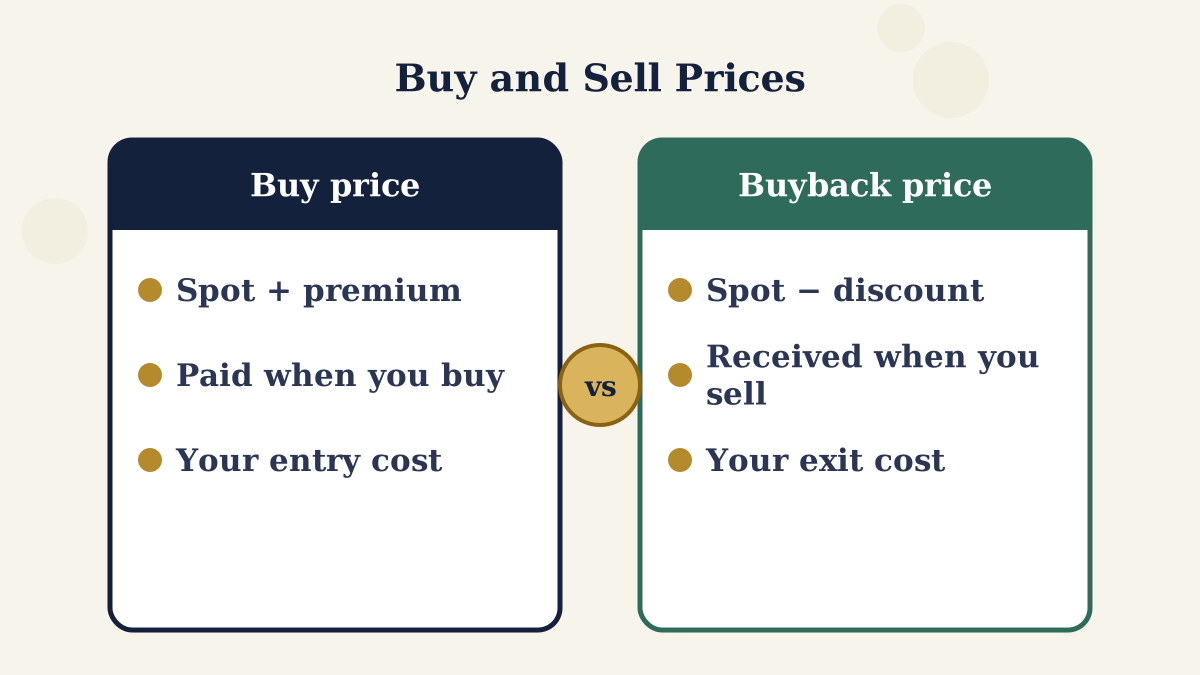
The spread is the gap between what a dealer sells for and what it pays to buy back. It's your real round-trip cost. Common bullion often has a narrow spread, while collector coins can have a very wide one.
Ask any dealer two questions: what's the premium to buy, and what would you pay to buy it back today?
Red Flags
- Premiums far above the ranges in the table for the same product.
- "Exclusive" or "limited" coins sold mainly on their story.
- Refusal to quote spot or a buyback price.
- Pressure to buy proof or collector coins for an IRA.
Regulators have cited markups above 50% in fraud cases involving retirement savers. Our gold IRA scams guide covers the warning signs.
How to Keep Premiums Low
Choose 1 oz or Larger
Bigger pieces carry lower premiums per ounce.
Favor Common Bullion
Eagles, Maple Leafs, Buffalos and accredited bars.
Compare Two Dealers
Same product, same day, same quantity.
Pay by Wire
Card payments often cost more.
A Worked Example
Say spot gold is $4,000 and you're choosing between ten 1 oz Gold Eagles at $4,200 each and one 10 oz bar at $40,800. The coins cost $42,000, a $2,000 premium or 5%. The bar costs $40,800, an $800 premium or 2%.
The bar saves $1,200 up front. The coins are easier to sell in smaller pieces and widely recognized. Many buyers hold some of each. Whatever you choose, run the same math on every quote. These prices are illustrations, not real quotes.
Gold Premiums Over Spot FAQs
What is a premium over spot?
It's the amount a dealer charges above the metal's current market price. It covers minting, distribution, dealer costs and profit.
What is a normal premium on a 1 oz Gold Eagle?
It varies with demand. Typical retail ranges are often cited around 4% to 8% for 1 oz sovereign coins, and the lowest online dealer prices in November 2026 ran around 2% to 3%.
Why do small coins cost more per ounce?
Minting and handling costs are similar for small and large pieces, so they make up a bigger share of a small coin's price.
How do I calculate the premium?
Subtract the spot value of the metal from the price you're quoted, divide by the spot value and multiply by 100.
What premium is too high?
Premiums far above the typical range for a product, especially on coins described as rare, exclusive or collectible, are a warning sign. Regulators have cited markups above 50% in enforcement cases.
The Bottom Line
The premium over spot is the price of turning cash into metal. For common gold bullion, expect a few percent; for small coins, silver and collectibles, expect more. Always calculate it yourself and compare before you buy.