A gold IRA rollover moves money from a retirement account you already have, such as a 401(k), 403(b), TSP or IRA, into a self-directed IRA that can hold physical gold. Done directly between institutions, it isn't taxed and doesn't trigger penalties.
The key is how the money moves. A direct rollover or transfer is simple and safe. An indirect rollover, where a check is paid to you, comes with a 60-day deadline and possible tax withholding. Below, we cover which accounts qualify, the steps and the mistakes to avoid.
Which Accounts Can Be Rolled Over
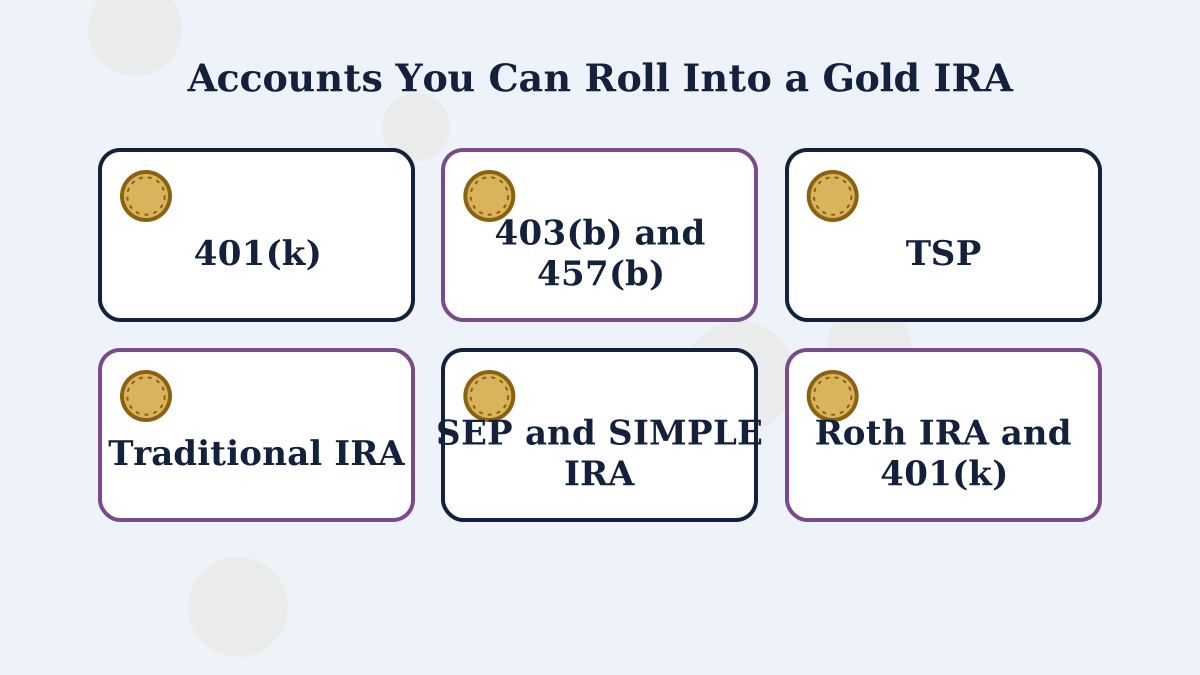
Most tax-advantaged retirement accounts can fund a gold IRA. Here are the common ones and what to know about each.
| Account | Can It Fund a Gold IRA? | Key Point | Our Guide |
|---|---|---|---|
| 401(k) from a former employer | Yes | Usually straightforward | 401(k) to gold IRA |
| 401(k) at your current job | Sometimes | Only if the plan allows in-service distributions | In-service rollover |
| Traditional IRA | Yes | Use a direct transfer | IRA to gold IRA |
| TSP | Yes, after separation or at 59½ | TSP has its own forms | TSP to gold IRA |
| 403(b) or governmental 457(b) | Usually, after separation | Plan rules apply | 403(b) to gold IRA |
| SEP IRA | Yes | Works like a traditional IRA | SEP IRA to gold IRA |
| SIMPLE IRA | Yes, after two years | Earlier moves can be penalized | SIMPLE IRA to gold IRA |
| Pension lump sum | Often | Must be an eligible rollover distribution | Pension to gold IRA |
| Roth IRA or Roth 401(k) | Yes, into a Roth gold IRA | Keep Roth money in a Roth | Roth gold IRA |
Direct vs. Indirect Rollovers
This is the most important choice you'll make, and the safest answer is almost always direct.
| Direct Rollover or Transfer | Indirect (60-Day) Rollover | |
|---|---|---|
| How money moves | Straight from the old custodian to the new one | A check is paid to you, and you redeposit it |
| Deadline | None | 60 days from when you receive the money |
| Tax withholding | None | Employer plans usually withhold 20% |
| Frequency limit | None | One IRA-to-IRA rollover per 12 months |
| Risk | Very low | Missing the deadline makes it taxable, plus a possible 10% penalty under 59½ |
With an indirect rollover from a 401(k), the plan typically withholds 20% for taxes. To roll over the full amount, you'd need to make up that 20% from other savings within 60 days and wait for a refund at tax time. That's why we'd only use an indirect rollover if a direct one isn't possible. Our rollover vs. transfer guide and 60-day rule guide go deeper.
Step-by-Step Gold IRA Rollover
- Check Your Current Account
Confirm the account type and whether you can move money now. For a workplace plan, ask about in-service rules and any forms required.
- Choose a Gold IRA Company
Compare minimums, published fees, storage and buyback. See our best gold IRA companies.
- Open the Self-Directed IRA
The company connects you with a custodian. Choose traditional or Roth to match the money you're moving.
- Request a Direct Rollover or Transfer
The new custodian or your gold company sends the request, or you sign your old provider's form asking for payment straight to the new custodian.
- Buy IRA-Eligible Metal
When the cash lands, choose your coins or bars. Ask for the price over spot and the buyback price in writing.
- Confirm Storage
The metal ships to an approved depository, and the custodian's statement shows what you own.
How Long a Rollover Takes
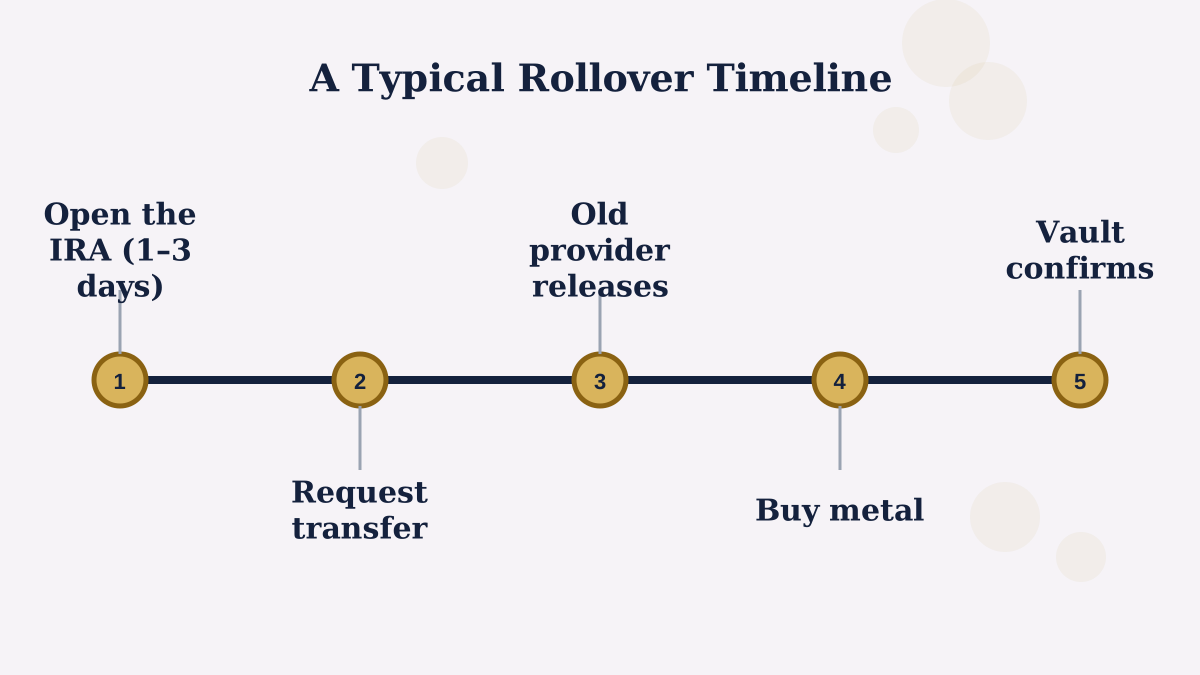
The new account usually opens within a few days. The slowest step is your old provider releasing the money. IRA-to-IRA transfers often take one to two weeks, while employer plans and the TSP can take longer.
Noble Gold, for example, says most of its rollovers finish within 5–10 business days. Our rollover timeline guide explains what speeds things up and what causes delays.
Taxes: When a Rollover Is and Isn't Taxed
A rollover is tax-free when pre-tax money moves to a pre-tax account, or Roth money moves to a Roth account, and it's done within the rules.
Tax applies when:
- An indirect rollover misses the 60-day deadline. The amount becomes a taxable distribution, possibly with a 10% penalty if you're under 59½.
- You move pre-tax money into a Roth gold IRA. That's a Roth conversion, and the converted amount is taxable income.
- You take personal possession of IRA metal. That's treated as a distribution.
A partial rollover is perfectly fine. Many people move only a share of their savings into gold and leave the rest invested as it was.
Common Rollover Mistakes
Taking the Check Yourself
It starts a 60-day clock and, for 401(k)s, usually triggers 20% withholding.
Doing Two Indirect IRA Rollovers in a Year
Only one is allowed per 12 months. Direct transfers avoid this limit entirely.
Moving Everything Into Gold
Most people keep metals to a modest share of their savings.
Buying Collectibles or Taking Delivery
Proof and rare coins can carry big markups, and IRA metal can't be stored at home.
How Much Should You Roll Over?
There's no IRS limit on how much you roll over, but there is a practical one: gold pays no income and its price can fall for years. Many planners suggest keeping precious metals to a modest slice of retirement savings rather than moving everything.
A partial rollover gives you exposure to gold while keeping the rest of your portfolio diversified. Our guide to how much gold to hold walks through common approaches.
Gold IRA Rollover FAQs
Is a gold IRA rollover taxable?
Not when it's done correctly. A direct rollover or trustee-to-trustee transfer moves money between retirement accounts without tax or penalties. Problems arise with indirect rollovers that miss the 60-day deadline.
Is there a limit on how much I can roll over into a gold IRA?
No. Rollovers and transfers aren't capped by the yearly IRA contribution limit. You can move all or part of an eligible account.
Can I roll over my 401(k) while I still work for the employer?
Only if your plan allows an in-service distribution, which many plans offer from age 59½. Check with your plan administrator.
How long does a gold IRA rollover take?
Many IRA-to-IRA transfers finish within one to three weeks. Employer plans and the TSP can take longer. Noble Gold says most of its rollovers complete within 5–10 business days.
How many rollovers can I do in a year?
The IRS allows one indirect IRA-to-IRA rollover in any 12-month period. Direct trustee-to-trustee transfers and rollovers from employer plans don't count toward that limit.
Ready to Start Your Rollover?
A gold IRA rollover is mostly paperwork, and a good gold IRA company does much of it with you. Choose a direct transfer, decide how much to move, and get prices and fees in writing before you buy.
If you'd like a step-by-step walkthrough first, Noble Gold's free Wealth Kit includes an IRA setup guide that covers the rollover from start to finish.