Inside an IRA, gold is taxed by IRA rules, not as a collectible. Buying and selling metal inside the account isn't taxed. Traditional gold IRA withdrawals are taxed as ordinary income, while qualified Roth withdrawals are tax-free. Before 59½, most withdrawals also face a 10% additional tax.
That's a meaningful difference from gold held at home, where long-term gains can be taxed at up to 28% as collectibles.
Taxes at Each Stage
| Stage | Traditional Gold IRA | Roth Gold IRA |
|---|---|---|
| Contributions | Often deductible | After-tax; not deductible |
| Rollovers and transfers | Not taxed if direct | Not taxed if direct |
| Buying and selling inside | Not taxed | Not taxed |
| Withdrawals | Taxed as ordinary income | Qualified withdrawals tax-free |
| Early withdrawals (before 59½) | Income tax plus 10% in most cases | Earnings may be taxed and penalized |
| In-kind metal distributions | Fair market value taxed as income | Qualified distributions tax-free |
| RMDs | From 73 | None for the original owner |
Why IRA Gold Avoids the Collectibles Rate
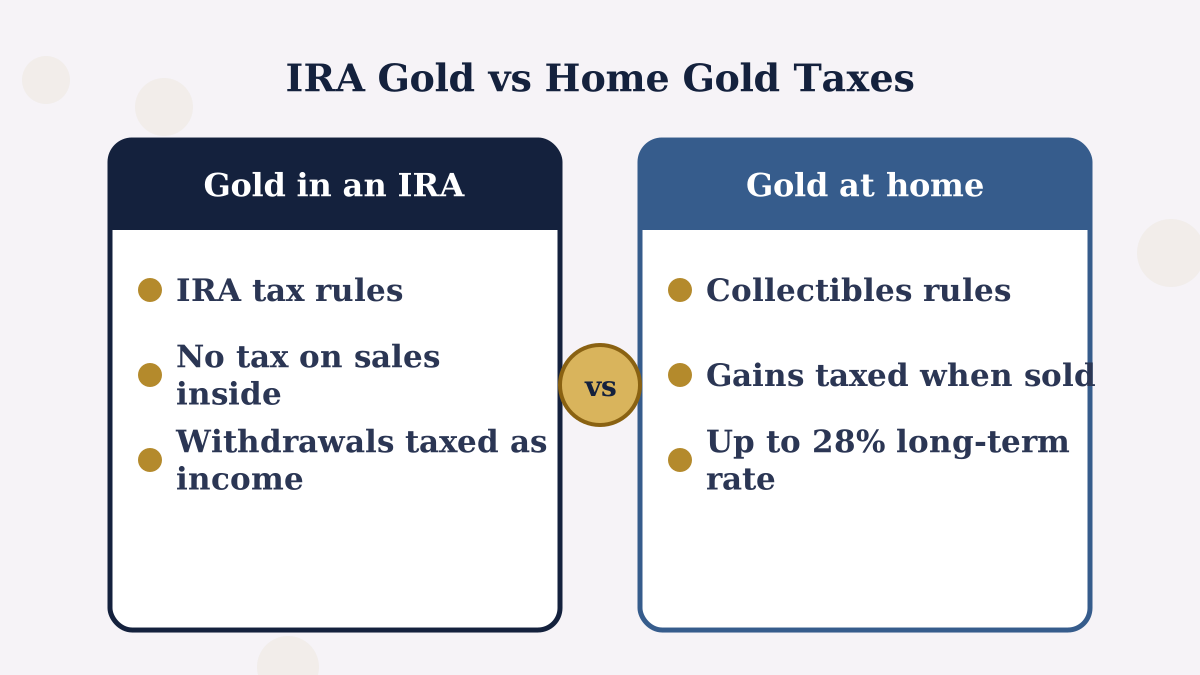
Outside retirement accounts, physical gold is a collectible for tax purposes, with long-term gains taxed at up to 28%. Inside an IRA, the metal isn't taxed when it's sold. Instead, tax applies when money or metal leaves a traditional IRA, at your ordinary income rate. Our physical gold taxes guide covers gold held at home.
Early Withdrawal Penalty and Exceptions
Most withdrawals before 59½ face a 10% additional tax. Exceptions include disability, certain medical expenses, a first home purchase up to a lifetime limit, qualified education costs and substantially equal periodic payments. Rules are detailed, so check with a tax professional before relying on one. See our withdrawal rules guide.
In-Kind Distributions
If you take coins or bars out of a traditional IRA, their fair market value on the distribution date is taxable income. Your cost basis in that metal for later sale becomes that value. If you later sell it outside the IRA, gains from that point may be taxed under collectibles rules.
Roth Conversions
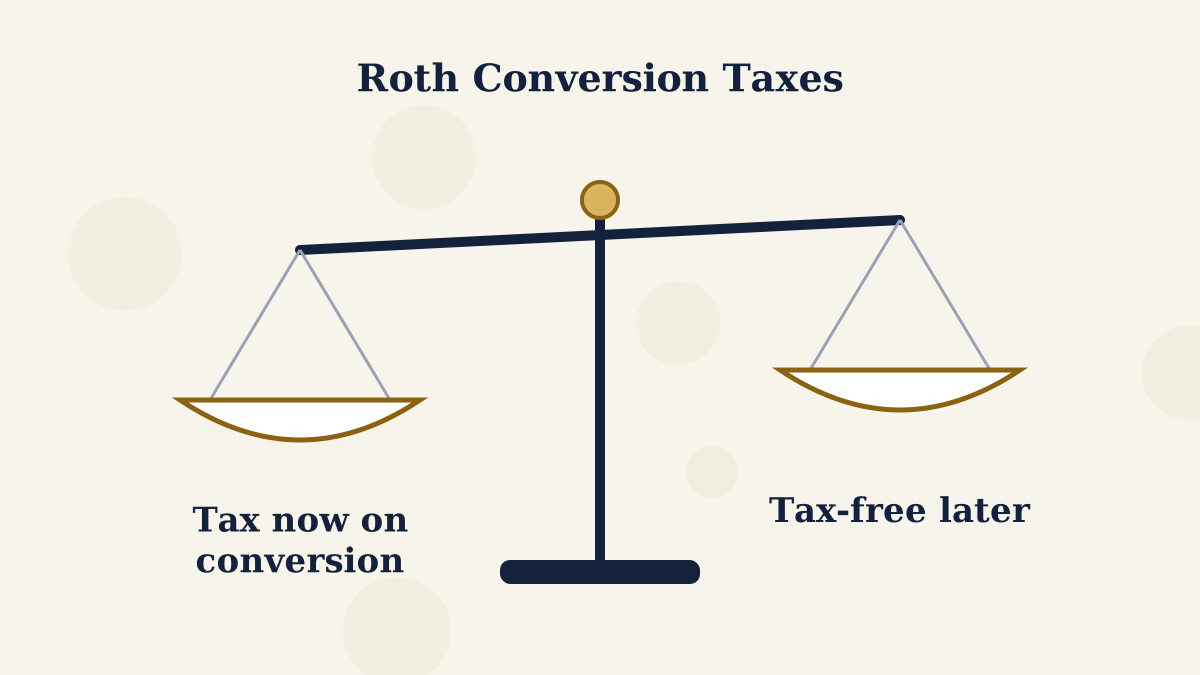
Moving money from a traditional IRA to a Roth gold IRA is a conversion. The converted amount is added to your income for that year. Some people convert in stages to manage brackets. See our Roth gold IRA guide.
Required Minimum Distributions
Traditional gold IRAs require minimum distributions starting at 73, or 75 for people born in 1960 or later. Missing one can trigger a 25% excise tax on the shortfall, reduced to 10% if corrected promptly. See our gold IRA RMD guide.
State Taxes
Most states tax traditional IRA withdrawals as income, though some exempt retirement income partly or fully. A few states have no income tax at all. Your state's rules apply to gold IRA withdrawals the same as any IRA.
Forms You'll See
Your custodian sends Form 5498 for contributions and year-end values, and Form 1099-R for distributions. You may file Form 8606 for Roth conversions or nondeductible contributions, and Form 5329 for penalties. See our tax forms guide.
An Example
Say you're 66 and take a $10,000 in-kind distribution of Gold Eagles from a traditional gold IRA. The $10,000 is added to your taxable income for the year, and your basis in those coins becomes $10,000. If you sell them two years later for $11,500 outside the IRA, the $1,500 gain is a long-term collectibles gain, taxed at up to 28%.
If the same coins came out of a Roth gold IRA as a qualified distribution, the $10,000 wouldn't be taxed, and your basis would still be $10,000 for any later sale.
Gold IRA Taxes FAQs
How is gold in an IRA taxed?
Like any IRA investment. Sales inside the IRA aren't taxed. Withdrawals from a traditional gold IRA are taxed as ordinary income; qualified Roth withdrawals are tax-free.
Does the 28% collectibles rate apply to gold IRAs?
No. The 28% maximum long-term rate applies to physical gold held outside retirement accounts. IRA withdrawals follow IRA rules instead.
Are in-kind gold distributions taxable?
From a traditional IRA, yes. The metal's fair market value on the distribution date counts as income. From a Roth, qualified in-kind distributions are tax-free.
Is there a penalty for early gold IRA withdrawals?
Generally a 10% additional tax before 59½, on top of income tax for traditional IRAs, unless an exception applies.
Do I owe tax when I buy gold for my IRA?
Not on the purchase itself. Funding by direct rollover or transfer isn't taxable. Sales tax generally doesn't apply to metal delivered to an IRA depository, but rules vary by state.
The Bottom Line
Gold in an IRA follows IRA tax rules: no tax on sales inside, income tax on traditional withdrawals and tax-free qualified Roth withdrawals. That lets you hold and rebalance metal without the 28% collectibles rate that applies to gold at home.