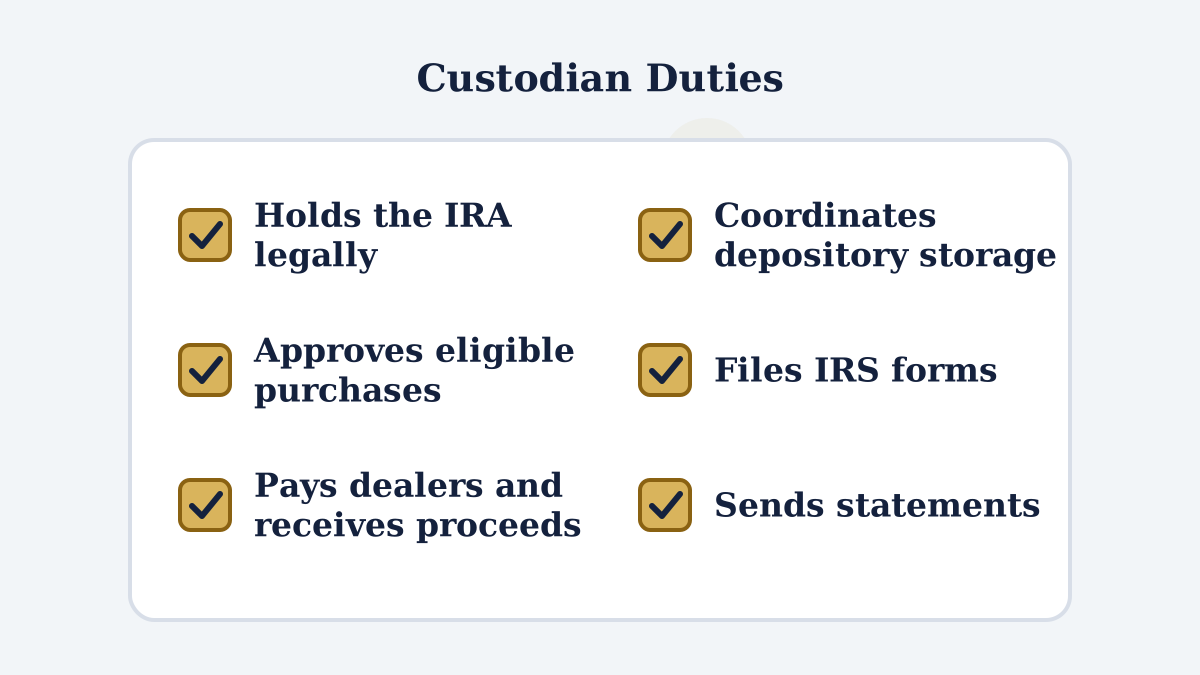
Every gold IRA needs a custodian (also called a trustee): a bank, federally insured credit union, savings and loan or an IRS-approved non-bank trustee. The custodian holds the account, approves and processes transactions, coordinates storage and reports to the IRS.
What it doesn't do matters just as much. Custodians don't give investment advice, don't judge whether a dealer's price is fair and don't stop you from making every possible mistake.
Who Can Be a Custodian
| Type | Notes |
|---|---|
| Banks | Including trust departments |
| Federally insured credit unions | Some offer self-directed IRAs |
| Savings and loan associations | Less common for metals |
| IRS-approved non-bank trustees | Most specialist self-directed custodians |
Most gold IRAs use specialist trust companies that focus on self-directed accounts. See our best gold IRA custodians page for names you'll often hear.
What the Custodian Does
- Holds legal title to the IRA's assets for your benefit.
- Processes purchases and sales you direct, paying dealers from IRA cash.
- Coordinates storage with approved depositories.
- Processes distributions, including in-kind delivery and RMDs you request.
- Reports to the IRS on Forms 5498 and 1099-R.
- Sends statements showing holdings and values.
What the Custodian Doesn't Do
- Give investment advice or recommend products.
- Check whether prices are fair or compare dealers.
- Prevent every mistake, such as a prohibited transaction you arrange outside the account.
- Guarantee the value of your metal.
That's why choosing a reputable dealer and understanding the rules still falls on you. Our prohibited transactions guide explains the biggest risks.
Reporting and Statements
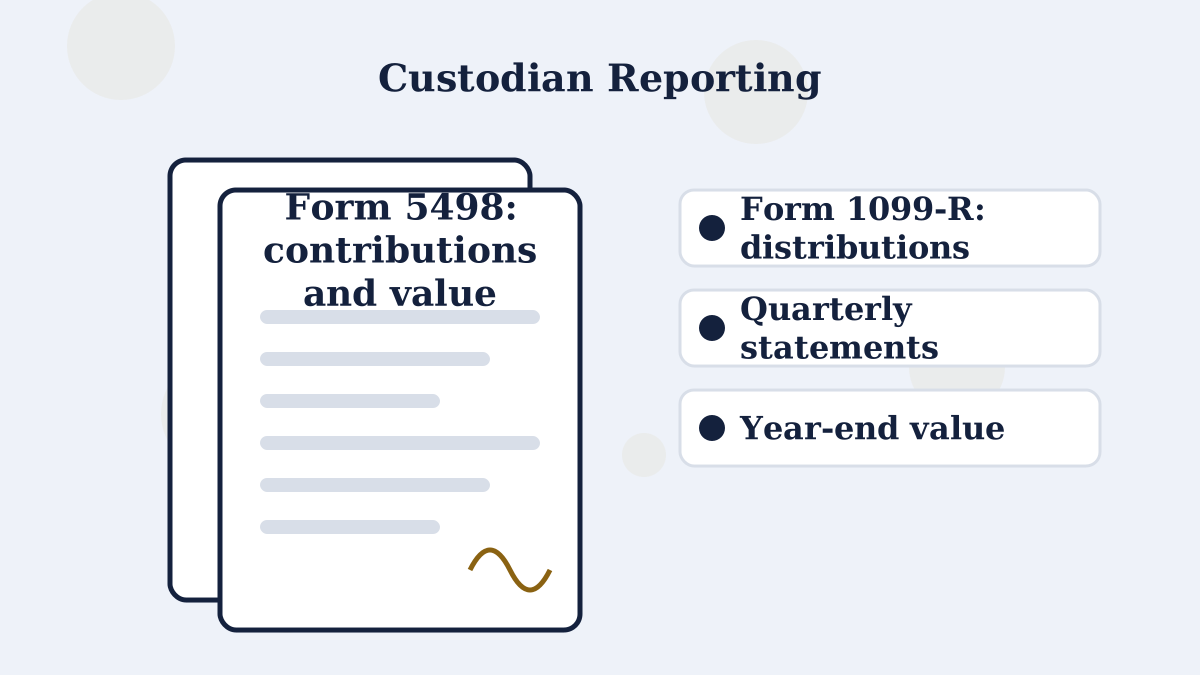
Your custodian files Form 5498 each year, showing contributions, rollovers, Roth conversions and the account's year-end fair market value. It files Form 1099-R for any distribution, including in-kind metal and RMDs. Regular statements list each product and quantity. See our tax forms guide.
Valuing Metal for Reports
Custodians value IRA metal each year for Form 5498 and RMD calculations, usually using market prices from a pricing source or the dealer. If you take an in-kind distribution, the metal's value on that date is reported on Form 1099-R.
Your Responsibilities
Direct the Investments
You choose what to buy and sell.
Follow the Rules
Avoid prohibited transactions and collectibles.
Take Required Distributions
From 73 for traditional IRAs; the custodian processes them when you request.
Keep Beneficiaries Updated
Forms are filed with the custodian.
Fees
Custodians charge setup and yearly fees, plus fees for some transactions. Storage may be billed through the custodian or the depository. Gold IRA companies often quote a combined price. Noble Gold publishes $125 a year for maintenance and $160 a year for storage. See our gold IRA fees guide.
How Purchases Flow Through the Custodian
When you decide to buy, you sign a purchase direction or approve the trade with your gold IRA company. The custodian checks that the product is allowed and that the IRA has enough cash, then wires payment to the dealer. The dealer ships the metal directly to the depository, which confirms receipt to the custodian.
Selling works in reverse: you direct a sale, the depository releases the metal to the buyer and the custodian receives the cash into your IRA. At no point does money or metal pass through your hands, which is what keeps the transaction inside the IRA.
Changing Custodians
You can move your gold IRA to another custodian with a trustee-to-trustee transfer. Depending on the custodians and depositories involved, metal may transfer in kind or be sold first. Ask about transfer-out fees before you start. Our transfer guide covers the process.
Gold IRA Custodian Rules FAQs
Who can be a gold IRA custodian?
A bank, a federally insured credit union, a savings and loan, or a non-bank trustee approved by the IRS.
Does the custodian check whether my metal is a good deal?
No. Custodians confirm that purchases are allowed and keep records, but they don't evaluate prices or give investment advice.
What forms does the custodian send?
Form 5498 for contributions, rollovers and year-end value, and Form 1099-R for distributions. You'll also get regular account statements.
Can a gold dealer be my custodian?
Usually not. The dealer sells metal; the custodian is a separate, regulated institution that holds the account.
The Bottom Line
The custodian keeps your gold IRA legal, recorded and reported, but it doesn't advise you or vet prices. Pick an established custodian, read your statements and remember the investment decisions and rule-following are yours.