An in-service rollover lets you move money from your current employer's 401(k) into an IRA, including a gold IRA, while you're still working there. It's only possible if your plan allows in-service distributions. Many plans allow them from age 59½, and some allow earlier rollovers of certain types of money.
You usually keep contributing to the 401(k) and keep receiving any match. You're simply moving part of your balance into physical metal.
Who Can Do an In-Service Rollover?
| Money Type or Situation | Typical Plan Rule |
|---|---|
| Any money, age 59½ or older | Often allowed |
| Money you rolled in from an old plan | Sometimes allowed at any age |
| After-tax (non-Roth) contributions | Sometimes allowed at any age |
| Employer match or profit sharing | Sometimes allowed after a set number of years |
| Your own pre-tax deferrals, under 59½ | Rarely allowed |
Rules vary widely. Your summary plan description or plan administrator has the answer.
How to Do It
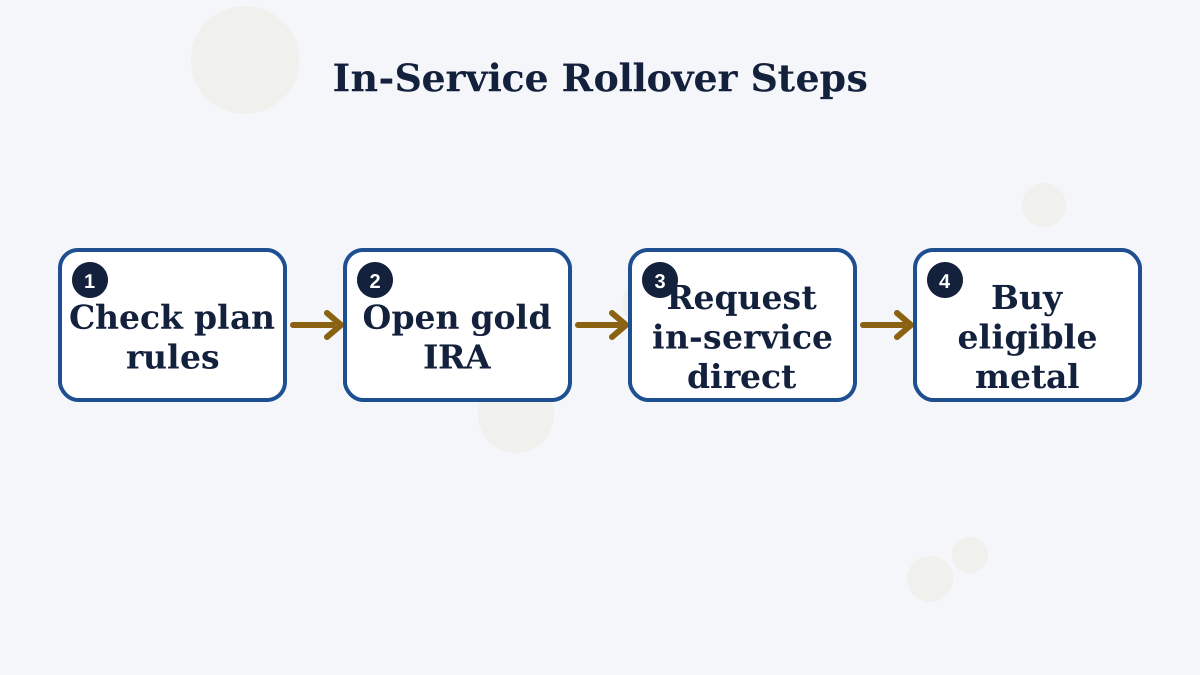
- Ask Your Plan What's Allowed
Which money types, minimum ages and how often.
- Open a Matching Gold IRA
Traditional for pre-tax money; Roth for Roth 401(k) money.
- Request a Direct In-Service Rollover
Ask the plan to pay the new custodian directly.
- Buy IRA-Eligible Metal
Choose bullion and confirm storage.
Why People Use In-Service Rollovers
- Access to physical metal. Most 401(k) plans don't offer bullion.
- More investment choice while still saving through payroll.
- Rebalancing part of a large 401(k) balance as retirement approaches.
See our can you hold gold in a 401(k) guide for what plans usually offer instead.
What You Might Give Up
- Plan loans: money moved out can't be borrowed against through the plan.
- Rule of 55: penalty-free access after leaving at 55 applies only to money in the plan.
- Low institutional fund costs in some large plans.
- Creditor protection differences between 401(k)s and IRAs, which vary by state.
Taxes
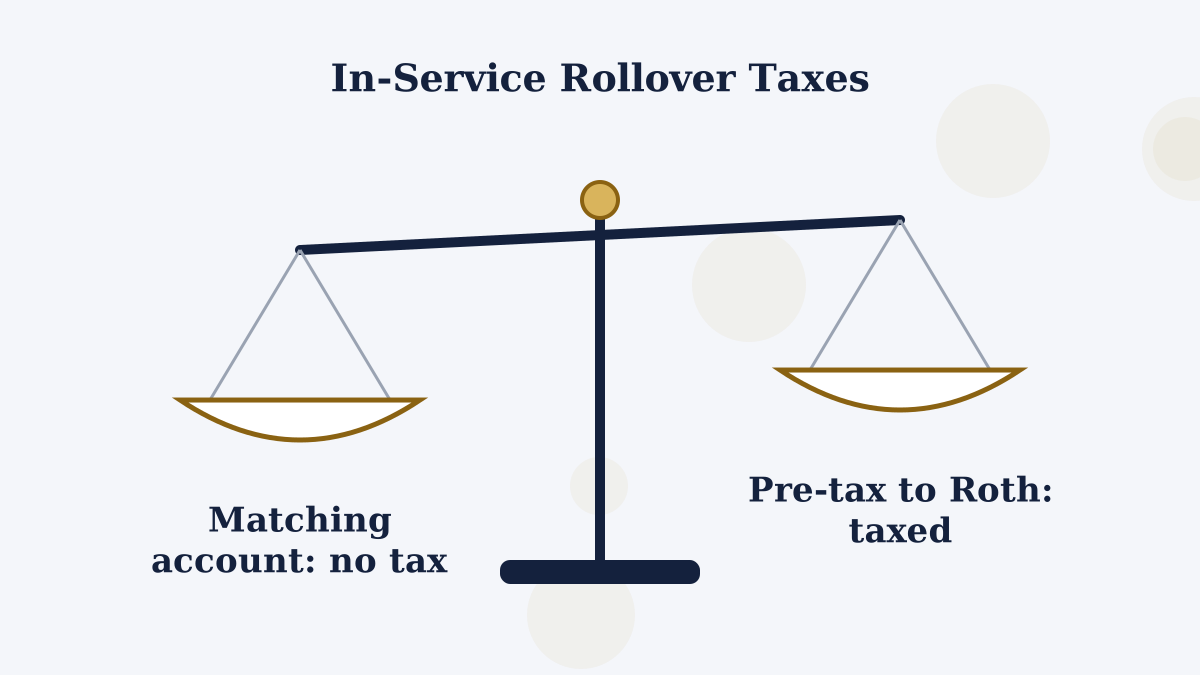
A direct in-service rollover to a matching account type isn't taxed. Moving pre-tax money into a Roth gold IRA is a taxable conversion. If the plan pays you instead, 20% is withheld and you'll have 60 days to complete the rollover. You'll receive a Form 1099-R either way.
How Much to Move
Most guidance suggests a modest share of total savings in metals. With an in-service rollover, you can move a small slice now and more later if the plan allows repeated withdrawals. Our how much gold to hold guide can help you set a target.
An Example
Say you're 60, still working and have $400,000 in your 401(k). Your plan allows in-service withdrawals at 59½. You decide on a 7% gold share, about $28,000. You open a traditional gold IRA, request a direct in-service rollover of $28,000 and keep contributing to your 401(k) with your employer's match.
The $28,000 clears Noble Gold's $20,000 IRA minimum, and its published yearly fees of about $285 work out to roughly 1% of that balance.
Questions to Ask Your Plan Administrator
- Does the plan allow in-service distributions, and from what age?
- Which money types are eligible: deferrals, match, rollover or after-tax money?
- How often can I take an in-service distribution?
- Can the payment go directly to my new IRA custodian?
- Will it affect my ability to keep contributing or take plan loans?
Ask for the answers in writing or check the summary plan description, so there are no surprises once the rollover starts.
In-Service 401(k) Rollover to Gold FAQs
What is an in-service rollover?
It's moving money out of your current employer's 401(k) into an IRA while you still work there. It's only possible if your plan allows in-service distributions.
At what age can I do an in-service rollover?
Many plans allow it from 59½. Some allow earlier in-service rollovers of certain money, such as rollover contributions or after-tax contributions.
Can I keep contributing to my 401(k) after an in-service rollover?
Usually yes. You stay in the plan, keep making contributions and keep receiving any employer match.
Is an in-service rollover taxable?
Not if it's a direct rollover to a matching account type.
The Bottom Line
If your plan allows in-service rollovers, you can add physical gold without leaving your job. Check the rules, use a direct rollover to a matching account and keep the rest of your 401(k) working, including the match.