A transfer moves money directly between two IRA custodians, and you never touch it. A rollover moves money from a workplace plan like a 401(k) into an IRA, or between IRAs by paying you first. Rollovers can be direct (sent to the new custodian) or indirect (paid to you, with 60 days to redeposit).
For a gold IRA, the rule of thumb is simple: use a direct method. A direct rollover from a 401(k) or a trustee-to-trustee transfer from another IRA avoids withholding, deadlines and limits.
The Three Methods Compared
| Feature | Direct Rollover | Indirect Rollover | Trustee-to-Trustee Transfer |
|---|---|---|---|
| Typical source | 401(k), 403(b), TSP | Any plan or IRA | Another IRA |
| Who receives the money | New custodian | You | New custodian |
| Tax withholding | None | 20% from workplace plans | None |
| Deadline | None | 60 days | None |
| Frequency limit | None | One IRA-to-IRA per 12 months | None |
| Reported to IRS | Yes, as non-taxable | Yes | Generally not as a distribution |
| Risk of mistakes | Low | High | Low |
How a Trustee-to-Trustee Transfer Works
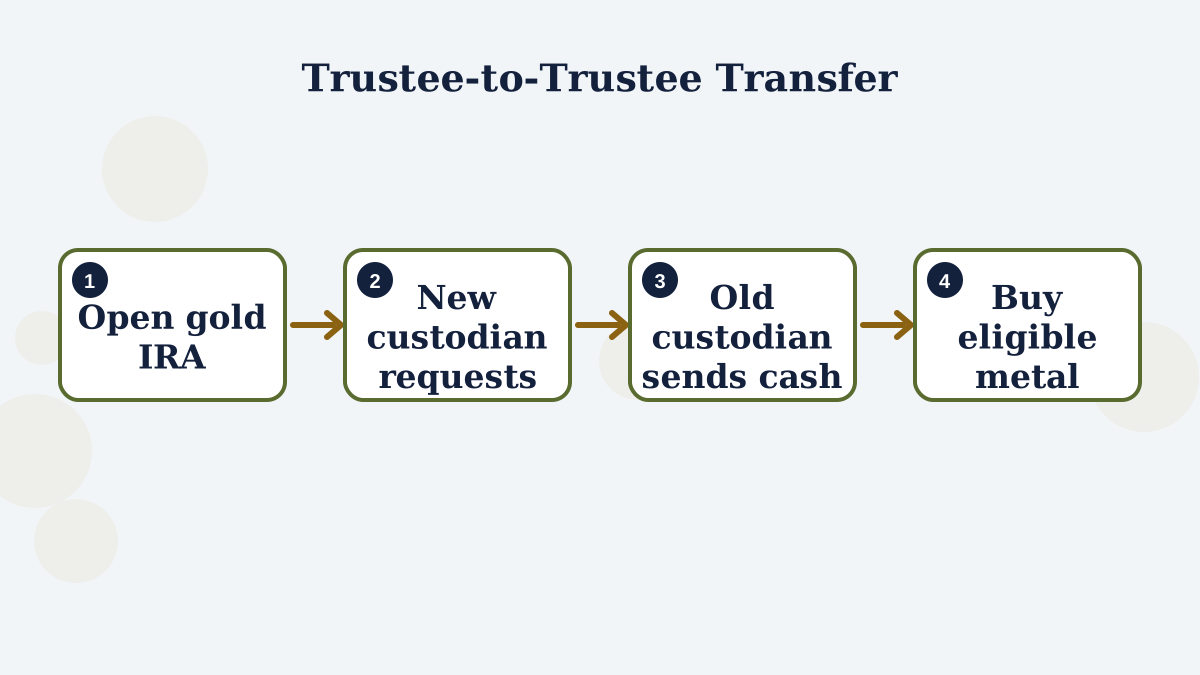
You open the gold IRA, and the new custodian sends a transfer request to your current one. The money moves between the two institutions. Because it's never paid to you, it isn't treated as a distribution, and you can do as many transfers as you like.
This is the usual way to move an existing traditional or Roth IRA into gold. See our IRA to gold IRA guide.
How a Direct Rollover Works
A direct rollover is the workplace-plan version. Your 401(k), 403(b) or TSP sends the money straight to your new custodian, payable for your benefit. No tax is withheld.
You'll receive a Form 1099-R showing the distribution, coded as a direct rollover, and your custodian reports the deposit on Form 5498. Our 401(k) to gold IRA rollover guide walks through it.
Why Indirect Rollovers Are Risky
With an indirect rollover, the money is paid to you. From a workplace plan, 20% is withheld for federal tax. To avoid tax on the full amount, you must deposit 100% into the new IRA within 60 days, making up the withheld 20% from other savings.
For IRA-to-IRA indirect rollovers, you're limited to one in any 12-month period across all your IRAs. A second one is treated as a taxable distribution and may be an excess contribution. Our 60-day rule guide explains the details.
When Each Method Fits
Old 401(k), 403(b) or TSP
Direct rollover. Simple and tax-free.
Existing IRA at a Bank or Broker
Trustee-to-trustee transfer. Unlimited and not a distribution.
Already Received a Check
Indirect rollover within 60 days, replacing any withholding.
Moving a Gold IRA to Another Company
Transfer, sometimes in kind. See our transfer guide.
Common Terminology Mix-Ups
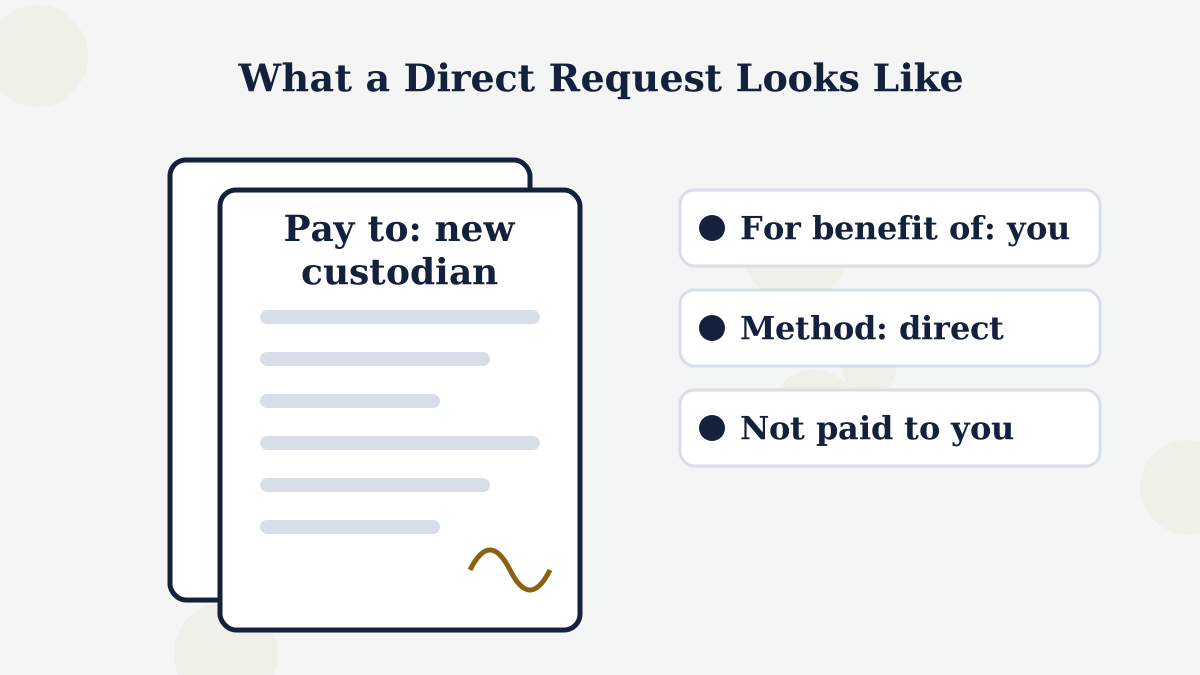
Many companies use "rollover" loosely to mean any move into a gold IRA. What matters is how the money travels. If a form asks whether you want funds paid to you or to the new custodian, choose the new custodian.
If you're moving an existing gold IRA to another company, see our transfer guide.
Transfers In Kind
Some transfers move assets themselves rather than cash. Between two gold IRA custodians, metal can sometimes move in kind, staying in the same depository or shipping to a new one, without being sold. Brokerage IRAs, by contrast, usually transfer cash, so you sell first.
Ask both custodians whether an in-kind transfer is possible and what it costs. Selling and rebuying adds a second dealer spread, so in-kind is often cheaper when it's available.
An Example
Say you have $60,000 in an old 401(k) and $40,000 in an IRA at a brokerage, and you want $25,000 in gold. You could ask the 401(k) for a direct rollover of $25,000 into a traditional gold IRA, or sell $25,000 in the brokerage IRA and request a trustee-to-trustee transfer.
Both routes are tax-free and avoid deadlines. The choice often comes down to which account you'd rather draw from and which has higher fees.
Gold IRA Rollover vs Transfer FAQs
What's the difference between a rollover and a transfer?
A rollover moves money from a workplace plan like a 401(k) into an IRA, or between IRAs via a payment to you. A transfer moves money directly between two IRA custodians, without it ever being paid to you.
Which is better for a gold IRA?
A direct method. Use a direct rollover from a 401(k) or a trustee-to-trustee transfer from another IRA. Both avoid withholding, deadlines and limits.
Does the once-per-year rule apply to transfers?
No. The one-rollover-per-12-months rule applies only to indirect IRA-to-IRA rollovers. Direct transfers and rollovers from workplace plans don't count.
Are transfers reported to the IRS?
Trustee-to-trustee transfers between IRAs generally aren't reported as distributions. Direct rollovers from a 401(k) are reported on Form 1099-R with a non-taxable code.
The Bottom Line
Transfers move money between IRAs; rollovers move it from workplace plans. Either way, keep it direct. Direct rollovers and trustee transfers are tax-free, unlimited and free of deadlines, which is exactly what you want when moving retirement money into gold.