An IRA to gold IRA transfer moves money from an IRA you already have, at a bank or brokerage, into a self-directed IRA that holds physical metal. When done as a direct trustee-to-trustee transfer, it isn't a distribution, isn't taxed and isn't limited in how often you can do it.
You can move your whole IRA or just part of it. Many people transfer only the share they want in gold and leave the rest invested where it is.
Which IRAs Can Move Into Gold
| Your Current IRA | Moves Into | Notes |
|---|---|---|
| Traditional IRA | Traditional gold IRA | Tax-free by direct transfer |
| Roth IRA | Roth gold IRA | Tax-free; your Roth five-year clock carries over |
| SEP IRA | Traditional or SEP gold IRA | Treated like a traditional IRA |
| SIMPLE IRA | Traditional gold IRA | Only after two years of participation |
| Inherited IRA | Inherited gold IRA | Special rules; see our inherited IRA guide |
Moving a traditional IRA into a Roth gold IRA is a Roth conversion and is taxable. Our Roth gold IRA guide covers when that can make sense.
Transfer vs. Rollover
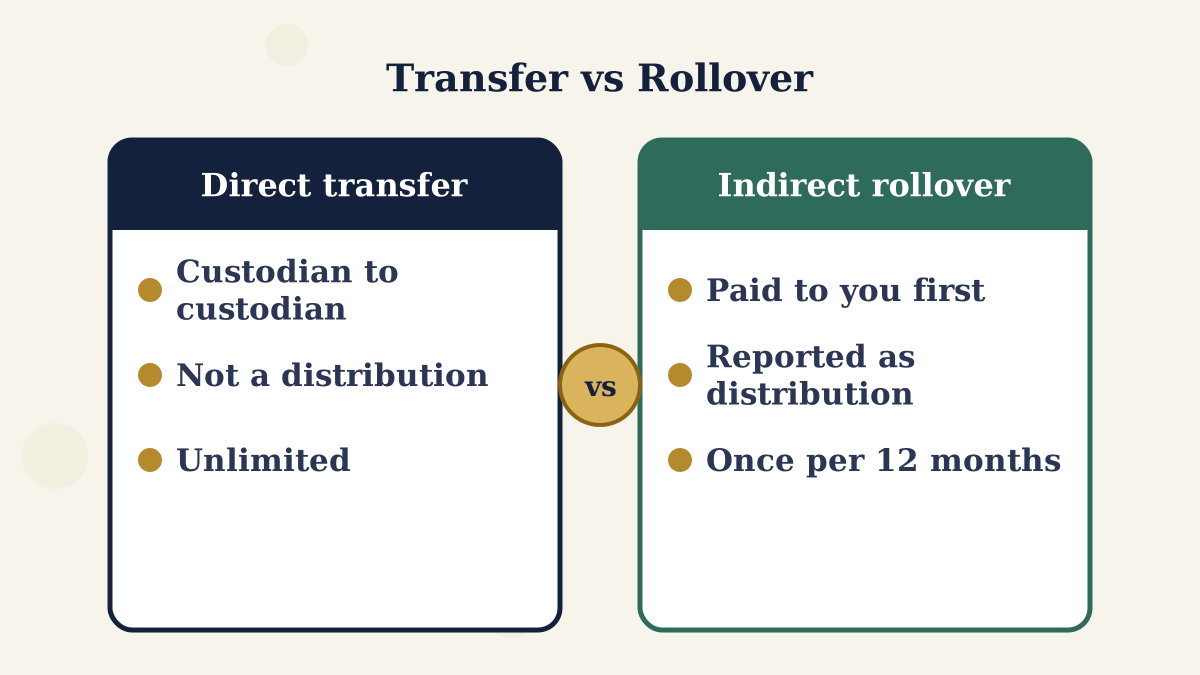
With a direct transfer, your current custodian sends the money straight to your new one. You never touch it, and it isn't reported as a distribution.
With an indirect rollover, the money is paid to you and you have 60 days to deposit it into the new IRA. You can do only one indirect IRA-to-IRA rollover in any 12-month period, across all your IRAs. Miss the deadline or break the limit, and the money becomes taxable. Our rollover vs. transfer guide explains the differences.
Step-by-Step: Transferring an IRA Into Gold
- Decide How Much to Move
Pick the share of your savings you want in physical metal.
- Open a Matching Gold IRA
Traditional to traditional, Roth to Roth.
- Sell What You're Moving
Most brokerages send cash. Sell only the investments you plan to transfer.
- Request the Transfer
Your new custodian or gold company usually sends the transfer form to your current custodian.
- Buy Eligible Metal
Once cash arrives, choose IRA-eligible bullion and confirm prices.
- Confirm Storage and Records
Check your purchase confirmation and first statement match.
How Long It Takes
Transfers from major brokerages often complete within one to two weeks. Some custodians need a signed form or a medallion signature guarantee, which can add time. Our rollover timeline guide breaks down each stage.
Partial Transfers
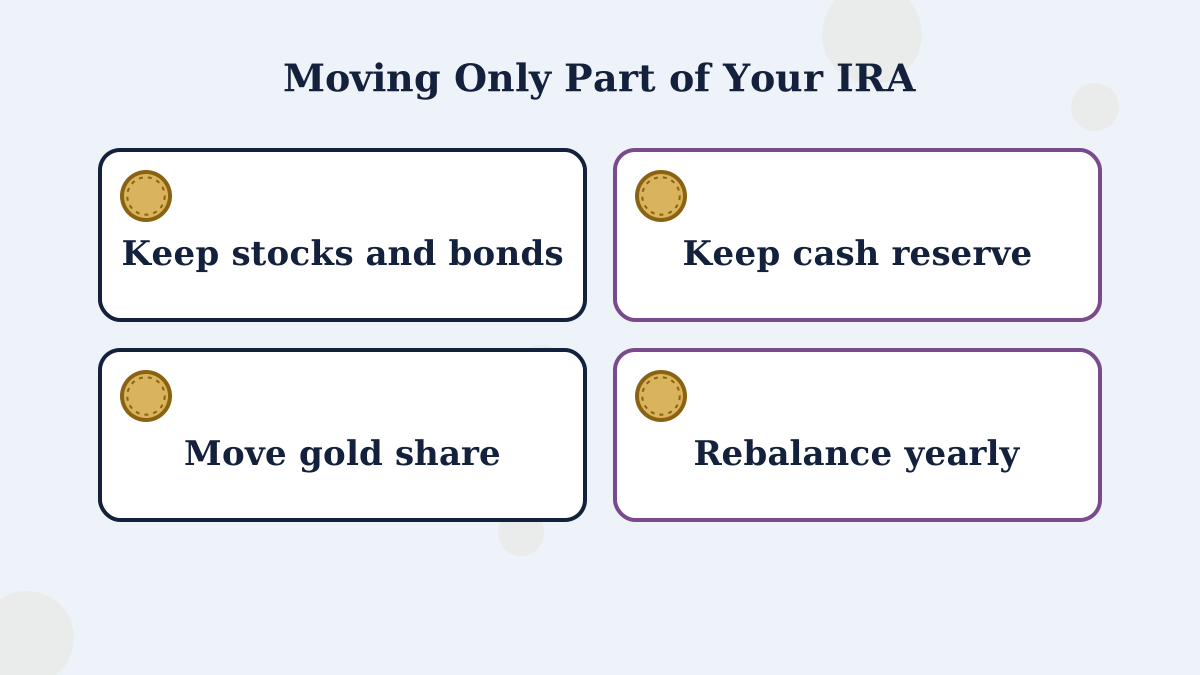
You don't have to move everything. A partial transfer lets you keep your current investments and add a gold allocation alongside them. That's often the most sensible approach, since most guidance suggests a modest share in metals.
If you have several IRAs, you can pick which one to move from. Some people transfer from an account that already holds cash, which avoids selling other investments.
Costs to Compare
Your current IRA may cost little or nothing to hold. A gold IRA adds setup, custodian and storage fees, plus a dealer spread on the metal. Noble Gold publishes a $50 setup fee, $125 a year for maintenance and $160 a year for storage.
Also ask your current custodian about any transfer-out or account-closing fee. Our gold IRA fees guide explains each cost.
Common Mistakes
- Taking a check yourself, then missing the 60-day window or breaking the once-a-year rule.
- Mixing account types, like sending Roth money into a traditional gold IRA.
- Moving more than planned because a salesperson suggested it.
- Forgetting RMDs: if you're 73 or older, take this year's RMD before moving money, since RMDs can't be rolled over.
Moving a Roth IRA Into Gold
A Roth IRA moves into a Roth gold IRA the same way, by direct transfer, and stays tax-free. Your Roth five-year clock is based on your first Roth IRA contribution, so transferring doesn't restart it.
Roth gold IRAs have no RMDs for the original owner, which suits gold you'd like to hold for the long term. See our Roth gold IRA guide.
IRA to Gold IRA Transfer FAQs
Can I move my IRA into a gold IRA?
Yes. You can transfer all or part of a traditional, Roth, SEP or SIMPLE IRA (after the SIMPLE's two-year period) into a self-directed gold IRA of the same type.
Is an IRA to gold IRA transfer taxable?
No, if it's a direct trustee-to-trustee transfer between the same account types. It isn't reported as a distribution.
How often can I transfer my IRA?
Direct transfers are unlimited. The once-every-12-months limit applies only to indirect IRA-to-IRA rollovers, where the money is paid to you first.
Do I have to sell my investments first?
Usually yes. Most brokerages transfer cash to a gold IRA custodian, so you sell the investments you want to move before the transfer.
The Bottom Line
Moving an existing IRA into gold is straightforward with a direct transfer: open a matching gold IRA, sell what you're moving and let the custodians handle the rest. It's tax-free, unlimited and doesn't require moving your whole account.