Most guidance suggests holding gold as a modest slice of your total savings. Ranges commonly cited by planners and financial media run from about 5% to 10%, and some stretch to 15%. Very few mainstream sources suggest going much higher.
There's no single right number. The best share for you depends on your age, how much income you need, what else you own and how you'd feel if gold dropped by a third.
Commonly Cited Ranges
| Framing | Typical Range | Who It's Usually Aimed At |
|---|---|---|
| Light diversifier | About 1%–5% | Younger savers, growth-focused portfolios |
| Common rule of thumb | About 5%–10% | Most long-term savers |
| Upper range | About 10%–15% | Conservative savers, some retirees |
| Above 15% | Rarely recommended | High conviction; higher risk |
These are ranges you'll see repeated across planners and financial publications, not a guarantee of results. Gold's past performance doesn't predict its future.
Why a Modest Slice
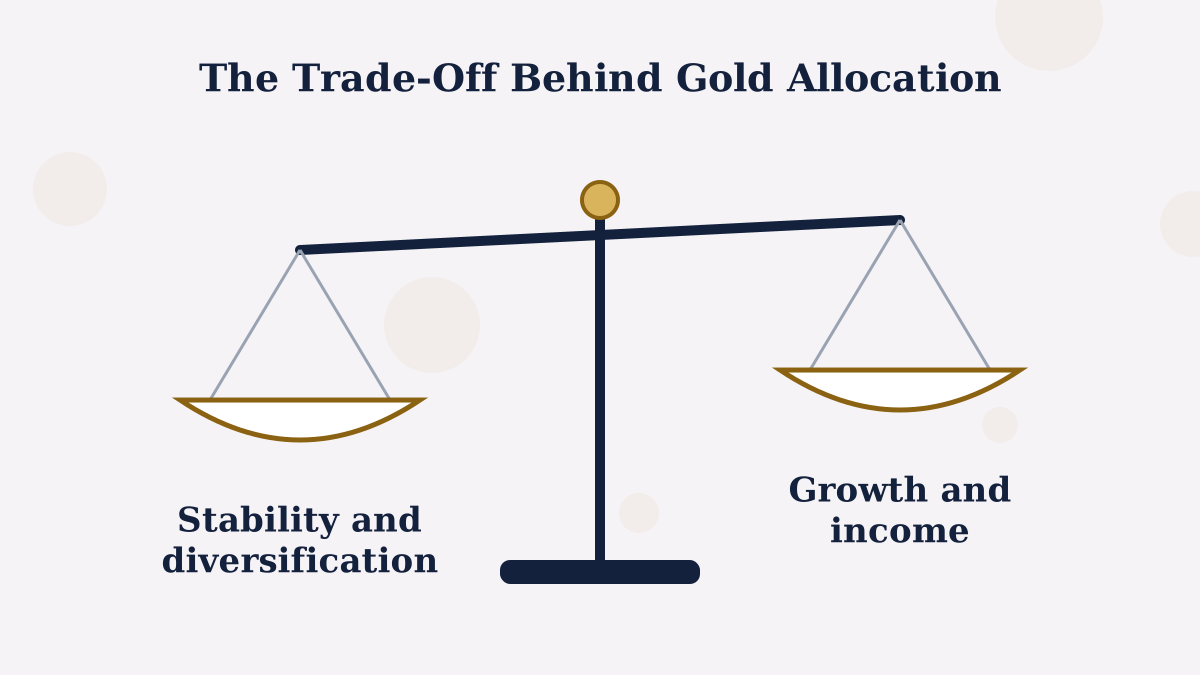
Gold can move differently from stocks and bonds, which is why it's often used as a diversifier. But it pays no interest or dividends, and it can fall hard: it lost more than half its value in the early 1980s and spent years recovering.
A small share gives you some of the diversification benefit without making your retirement depend on gold's price. As one common way of putting it, a plan should benefit when gold does well, not rely on it.
Factors That Change the Number
Age and Time Horizon
Younger savers usually prioritize growth. Near-retirees may value stability more.
Income Needs
If you'll be drawing income soon, you need assets that produce it or are easy to sell.
What You Already Own
Gold funds, mining stocks or coins at home all count toward your share.
Risk Tolerance
If a big drop in gold would cause you to sell in a panic, hold less.
An Example
Say you have $400,000 in retirement savings and want a 7% gold share. That's $28,000 in gold. If you already hold $5,000 of gold coins at home, you might put about $23,000 into a gold IRA.
That amount clears Noble Gold's $20,000 IRA minimum, and the $285 a year in published fees works out to about 1.2% of the IRA balance. That cost share falls as the balance grows. Try our fee calculator for your own numbers.
Keeping Your Share on Target
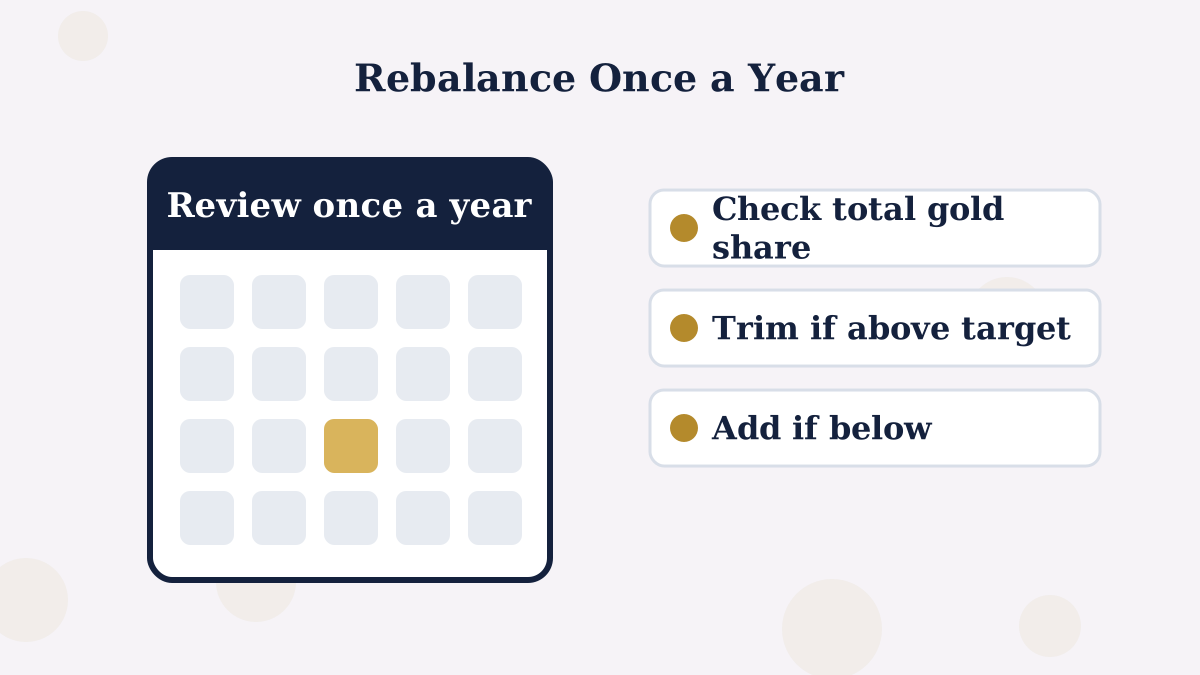
Gold's price can push your share well above or below your target. A once-a-year review keeps things in line. If gold rises sharply, you might sell some metal inside the IRA, with no tax on the sale, and buy other investments.
Our rebalancing guide explains how to do this inside and outside an IRA.
Common Mistakes
- Going all in after a big rally. Large gold positions bought near peaks have historically taken years to recover.
- Ignoring gold you already own. ETFs and coins at home count.
- Forgetting about RMDs. A traditional gold IRA needs enough liquidity for required distributions from 73.
- Letting a salesperson set the number. Decide your share first, then choose a company.
Lump Sum or Build Over Time
Once you've picked a target, you can buy it all at once or build up over several purchases. A lump sum is simpler and can save on repeated transaction costs. Spreading purchases out reduces the risk of buying everything right before a drop.
Inside a gold IRA, a common approach is to fund the account by rollover in one step, then decide whether to buy all the metal at once or keep part in cash for a later purchase. Ask your company whether additional purchases carry extra fees.
Gold Outside Your IRA Counts Too
Your gold share should include everything: IRA metal, coins at home, gold ETFs in a brokerage account and gold funds in your 401(k). Many people are surprised to find they already hold some gold exposure through funds.
Keeping part of your gold outside retirement accounts gives you access without IRA rules, but it's taxed differently. Our gold IRA vs. physical gold guide compares the two.
How Much Gold in a Retirement Portfolio FAQs
What percentage of my portfolio should be in gold?
Commonly cited ranges run from about 5% to 10%, with some sources stretching to 15%. There's no single right number; it depends on your age, income needs and how diversified you already are.
Is 20% in gold too much?
For most savers, that's above the ranges usually cited. Gold pays no income and can fall sharply, so a large share can limit growth and make withdrawals harder.
Should retirees hold more gold?
Some planners suggest retirees lean toward the upper end of the usual range for stability, but retirees also need income and liquidity, which gold doesn't provide.
Does gold in my IRA count toward my allocation?
Yes. Count all your gold, inside and outside retirement accounts, including gold funds, when you check your total share.
The Bottom Line
Gold works best as a modest part of a diversified plan. Pick a target range that fits your age, income needs and risk tolerance, count all your gold, and rebalance once a year.