Heirs can hold an inherited IRA in physical gold. A non-spouse heir moves the money by direct trustee-to-trustee transfer into an inherited self-directed IRA, titled in the original owner's name for the heir's benefit. A spouse has the extra option of treating it as their own IRA.
The key traps: non-spouse heirs can't do a 60-day rollover, and most must empty the account within 10 years. Gold can still make sense for part of that period, as long as the distribution schedule is planned.
Your Options Depend on Who You Are
| Beneficiary | Main Options | Distribution Rule |
|---|---|---|
| Surviving spouse | Treat as own IRA, or keep as inherited IRA | Own RMD schedule if treated as own |
| Minor child of the owner | Inherited IRA | Life expectancy until 21, then 10 years |
| Disabled or chronically ill heir | Inherited IRA | Life expectancy payments |
| Heir not more than 10 years younger | Inherited IRA | Life expectancy payments |
| Most other heirs (adult children, others) | Inherited IRA | Empty by end of year 10 |
| Estate or non-qualifying trust | Inherited IRA | Shorter schedules often apply |
These categories come from the SECURE Act rules. Your custodian and a tax professional can confirm which applies to you.
How to Move an Inherited IRA Into Gold
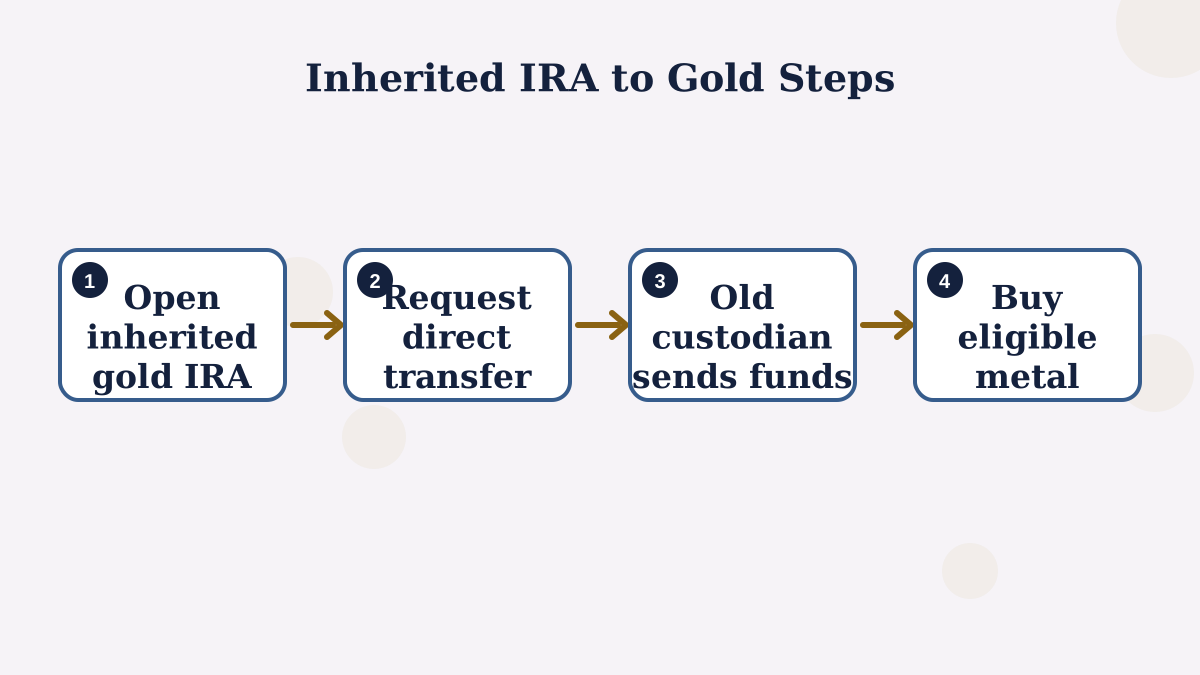
- Open an Inherited Self-Directed IRA
The account must be titled correctly, typically "[Owner's name], deceased, for the benefit of [your name], beneficiary."
- Request a Direct Transfer
Your new custodian requests the money from the current one. Don't take a check.
- Buy IRA-Eligible Metal
Choose bullion and confirm storage at an approved depository.
- Set Up Your Distribution Plan
Schedule withdrawals to meet the 10-year rule or any annual RMDs.
The 10-Year Rule and Annual RMDs
If the owner died before their required beginning date for RMDs, most heirs under the 10-year rule don't need annual withdrawals, but the account must be empty by December 31 of year 10. If the owner died on or after that date, heirs generally must also take annual RMDs in years one through nine.
Missing an RMD can trigger a 25% excise tax on the shortfall, reduced to 10% if corrected promptly. Our gold IRA RMD guide explains how to plan withdrawals with metal.
Spreading Withdrawals to Manage Taxes
From a traditional inherited IRA, every withdrawal is taxable income. Taking everything in year 10 could push you into a higher bracket. Many heirs spread withdrawals across the decade instead.
With gold, you can sell metal inside the IRA and withdraw cash, or take coins as an in-kind distribution. Smaller coins and bars make partial withdrawals easier.
Inherited Roth IRAs
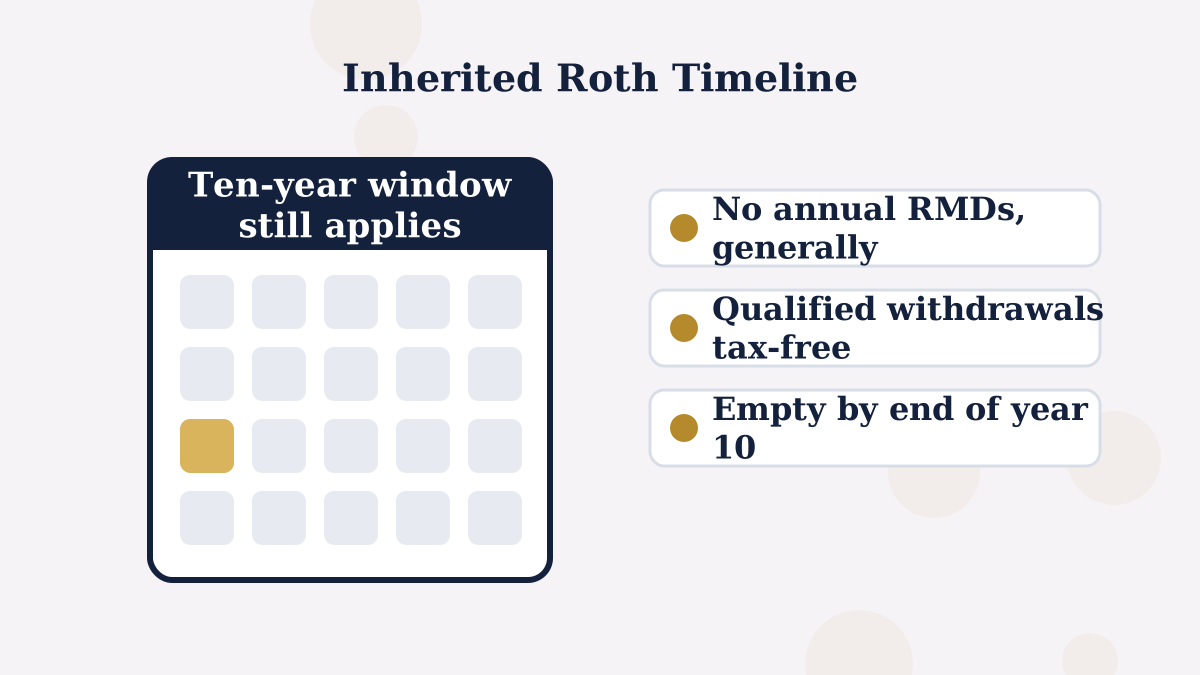
Inherited Roth IRAs follow the 10-year rule too, but heirs generally don't need annual withdrawals, and qualified withdrawals are tax-free. That means you can hold gold in an inherited Roth for the full decade and withdraw at the end, if that suits your plans.
Surviving Spouses
A spouse can treat an inherited IRA as their own, which means their own RMD age and schedule apply. That can be done by transferring into a gold IRA in the spouse's name. Some spouses keep it as an inherited IRA instead, for example to access money before 59½ without the 10% penalty. A tax professional can help you choose.
Mistakes to Avoid
- Taking a check as a non-spouse heir. It can't be rolled over and becomes taxable.
- Titling the account wrong. It must be set up as an inherited IRA.
- Mixing inherited money with your own IRA. Only spouses can combine them.
- Forgetting annual RMDs when the owner had already started taking them.
- Putting everything in metal when you'll need to withdraw it within 10 years.
Inherited IRA to Gold IRA FAQs
Can I move an inherited IRA into a gold IRA?
Yes. Non-spouse heirs can move it by direct trustee-to-trustee transfer into an inherited self-directed IRA that holds metal. Spouses can also roll it into their own IRA.
Can a non-spouse heir do a 60-day rollover of an inherited IRA?
No. Non-spouse beneficiaries can't roll inherited IRA money over themselves. Taking a check makes it a taxable distribution. Use a direct transfer.
What is the 10-year rule?
Most non-spouse heirs must empty an inherited IRA by December 31 of the tenth year after the owner's death. If the owner had already started RMDs, annual distributions are also generally required.
Do inherited Roth gold IRAs have annual RMDs?
Generally no for heirs under the 10-year rule, but the account must still be emptied by the end of year 10. Qualified withdrawals are tax-free.
Can I take the inherited gold coins instead of cash?
Yes. An in-kind distribution is allowed. From a traditional inherited IRA, it's taxed on the metal's value when distributed.
The Bottom Line
Inherited IRA money can be held in physical gold, but it has to move by direct transfer into a properly titled inherited IRA, and most heirs must empty it within 10 years. Plan your distributions first, then decide how much to hold in metal.