Gold has no earnings, so its price is driven by supply and demand and by what it costs to hold a metal that pays nothing. The biggest forces are real interest rates, the U.S. dollar, central bank buying, investor flows, fear and uncertainty and, to a lesser extent, mine supply.
These forces interact. In 2026, gold hit about $5,608 an ounce in January before easing to around $4,000 by early November, as analysts weighed central bank demand against shifting rate expectations.
The Six Main Drivers
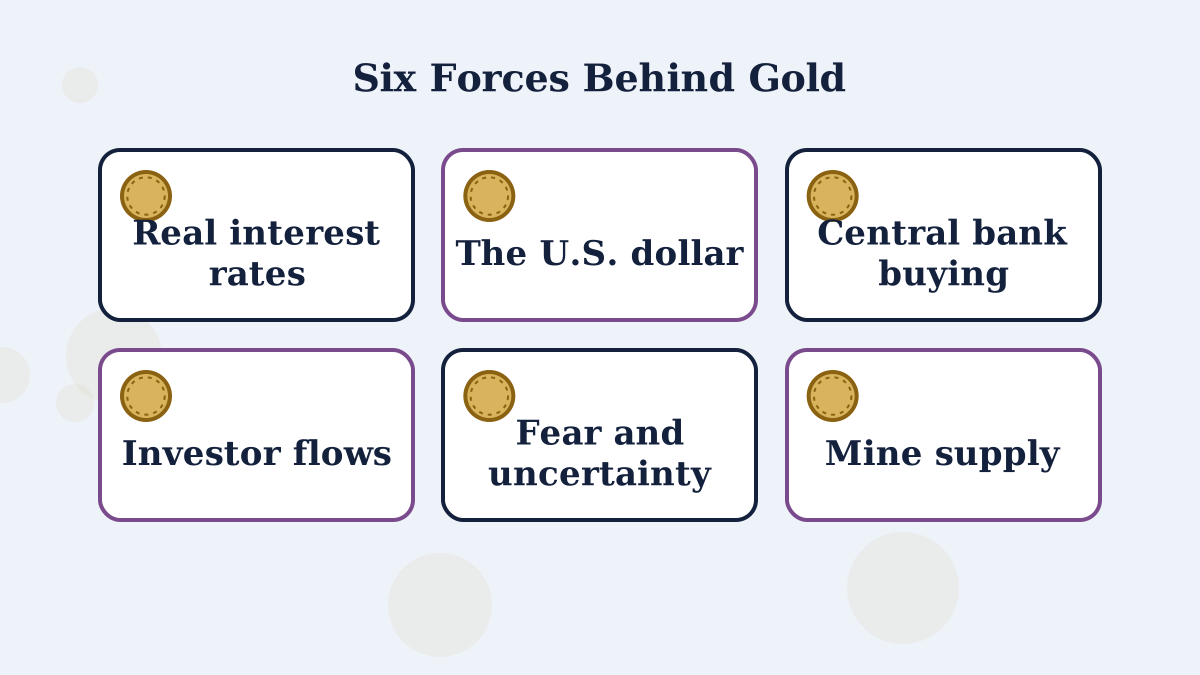
Here's how each force works, starting with the one analysts watch most closely.
1. Real Interest Rates
Real rates are interest rates after inflation. When they're high, cash and bonds pay a solid return, and holding gold means giving that up. When real rates are low or negative, gold's lack of income matters less, and it tends to do better.
For much of the past two decades, real rates explained a large share of gold's moves. That's why gold often reacts to Federal Reserve decisions and inflation data.
2. The U.S. Dollar
Gold is priced in dollars worldwide. When the dollar weakens, gold becomes cheaper for buyers using other currencies, which can raise demand and the dollar price. A strong dollar tends to do the opposite. The link isn't perfect, but it's one of the most watched.
3. Central Bank Buying
Central banks, especially in emerging markets, have been buying gold at record levels since 2022. Analysts commonly cite reasons such as diversifying reserves away from the dollar and reducing the risk of assets being frozen by sanctions.
Because central banks tend to buy steadily and hold for the long term, many analysts see their demand as a support under prices. Some argue it has weakened gold's traditional link to real rates.
4. Investor Flows
Gold ETFs, futures traders and individual buyers of bars and coins all add or remove demand. ETF flows often follow interest rate expectations. Futures trading can amplify short-term moves in both directions.
5. Fear and Uncertainty
Wars, political shocks, banking scares and recessions often push investors toward gold. These spikes can be fast, and they can reverse when fear fades. Our gold in a recession guide shows how this played out in 2008 and 2020.
6. Mine Supply and Jewelry Demand
Mine output changes slowly and adds only a small share to the large stock of gold already above ground. It rarely drives prices on its own. Jewelry demand, especially in India and China, matters more, but it often falls when prices are high.
How the Drivers Interact
| Scenario | Typical Pressure on Gold |
|---|---|
| Rate cuts, falling real rates | Supportive |
| Weaker dollar | Supportive |
| Strong central bank buying | Supportive |
| Geopolitical shock | Supportive, often short-lived |
| Rising real rates | Negative |
| Stronger dollar | Negative |
| Calm markets, strong stocks | Often negative or flat |
These are tendencies, not rules. Several forces often pull in different directions at once, which is why gold can swing sharply.
What It Means for You
If you're considering a gold IRA, you don't need to forecast these forces. What matters more is choosing a sensible allocation, keeping costs reasonable and holding for the long term.
Spot price also isn't the price you pay. Dealers add a premium, covered in our premiums over spot guide.
Gold's 2025–2026 Run in Context
Gold rallied strongly through 2025 and into early 2026, reaching about $5,608 an ounce in January 2026. Analysts widely credited central bank buying, expectations of interest rate cuts, a weaker dollar and geopolitical tension.
By early November 2026, gold had eased to around $4,000. That pullback is a reminder that even a strong run can reverse quickly, and that a high price today doesn't guarantee higher prices tomorrow.
What Drives Gold Prices FAQs
What is the biggest driver of gold prices?
Many analysts point to real interest rates, meaning rates after inflation. Since 2022, record central bank buying has also become a major force, and some say it has loosened gold's link to real rates.
Why does gold go up when the dollar falls?
Gold is priced in dollars, so a weaker dollar makes it cheaper for buyers using other currencies, which can lift demand and the dollar price.
Do central banks really move the gold price?
Their purchases have been large since 2022, and analysts widely credit them with supporting prices. Central banks buy to diversify reserves away from the dollar and reduce sanctions risk.
Does gold mining supply matter?
Less than you might think. Mine output changes slowly and adds only a small share to the huge existing stock of gold each year.
The Bottom Line
Gold's price reflects real interest rates, the dollar, central bank demand, investor flows and fear, with supply playing a smaller role. Because these forces shift constantly, gold works best as a long-term diversifier rather than a trade.