Yes, you can lose money in a gold IRA. Its value moves with the price of gold, which can fall sharply and stay down for long periods. You can also lose money through high markups, ongoing fees, selling at the wrong time or breaking IRS rules.
The good news is that most of these risks are within your control. Below, we explain the five ways people lose money in gold IRAs and what to do about each one.
Risk 1: The Price of Gold Falls
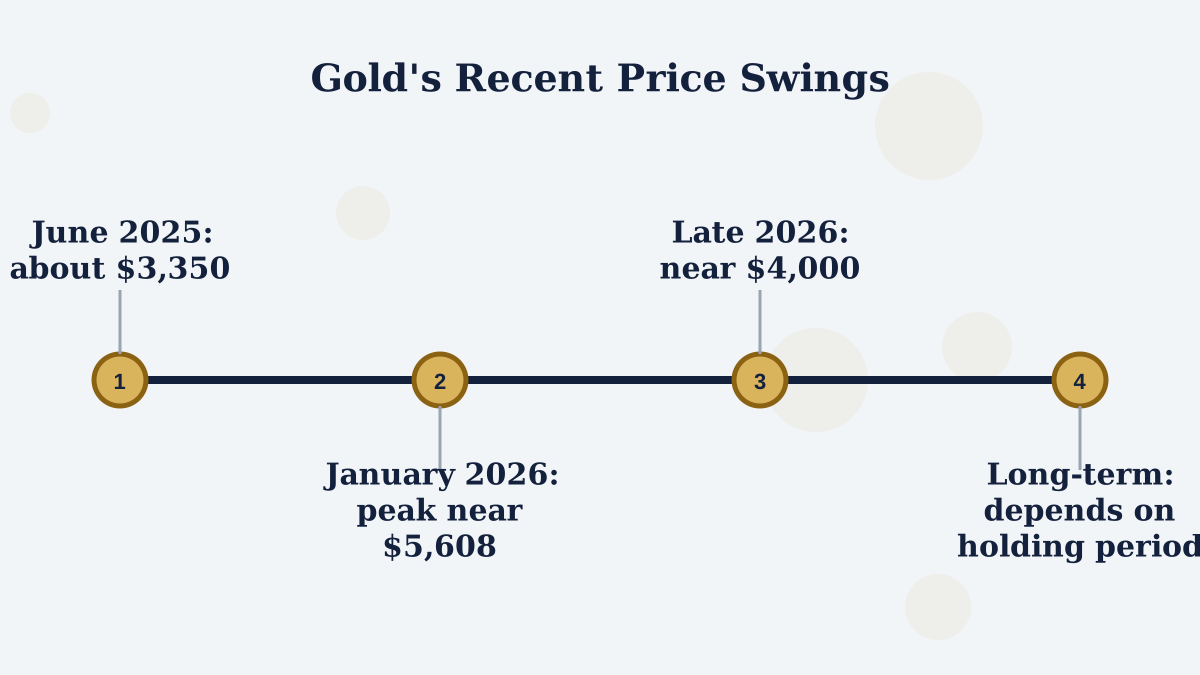
This is the biggest and most obvious risk. A gold IRA owns metal, so when gold's price falls, so does your account value. Recent history shows how fast it can move: gold rose from about $3,350 an ounce in June 2025 to a peak near $5,608 in January 2026, then fell back toward $4,000 by November 2026.
Over longer periods, gold has also had multi-year slumps where prices went sideways or down. Someone who bought near a peak could wait years to recover.
How to limit it: keep gold to a modest share of your savings, plan to hold for many years, and avoid putting money in a gold IRA that you'll need soon. Our how much gold to hold guide covers sizing.
Risk 2: Overpaying When You Buy
Every coin or bar costs more than its melt value. That premium, or spread, is your first loss: if you pay 5% over spot, gold has to rise more than 5% just for you to break even.
Some dealers push proof or collectible coins with much higher markups, which can take years of price gains to recover. That's one of the most common ways people lose money in gold IRAs.
How to limit it: buy common bullion, ask for the price over spot and the buyback price in writing, and compare quotes for the same coin. See our premiums over spot guide.
Risk 3: Fees Eat Into Returns
Gold IRAs carry yearly custodian and storage fees, usually a few hundred dollars combined. Because gold pays no income, those fees come straight out of your returns.
On a $10,000 account, $250 a year is 2.5%, so gold would have to rise that much every year just to stand still. On $100,000, the same fee is 0.25%, which is far easier to absorb.
How to limit it: choose flat fees, avoid tiny accounts and consolidate rather than holding several small IRAs. Our fee calculator shows the effect at your balance.
Risk 4: Selling at the Wrong Time
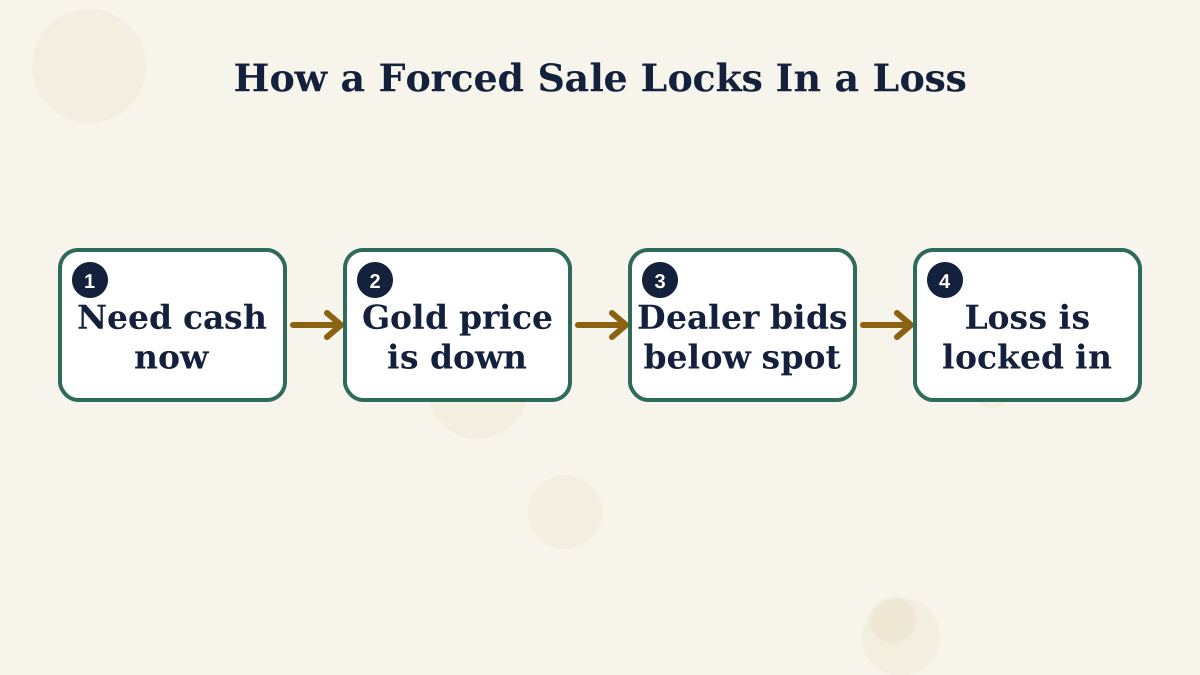
Selling gold IRA metal isn't instant. You request a bid, the custodian approves the sale and the proceeds settle. Dealers buy back below spot, so selling soon after buying locks in the round-trip spread.
Forced sales hurt most. If you need cash for a required minimum distribution or an emergency while gold is down, you crystallize the loss.
How to limit it: keep enough cash in the IRA or elsewhere to cover fees and RMDs, and consider taking an in-kind distribution instead of selling at a low point. See our RMD guide.
Risk 5: Breaking the Rules
IRS mistakes can cost far more than a price drop. Taking IRA metal home, missing a 60-day rollover deadline, doing two indirect IRA rollovers in a year or buying non-eligible coins can all trigger taxes and, before 59½, a 10% penalty. A prohibited transaction can disqualify the entire IRA.
How to limit it: use direct transfers, keep metal in an approved depository and buy only IRA-eligible bullion through your custodian. Our gold IRA rules guide covers the essentials.
What You're Protected Against
Some fears about gold IRAs are overblown. A properly set-up gold IRA gives you real protections:
Dealer Failure
Your metal belongs to your IRA and is held by an independent custodian and depository, not the dealer.
Theft or Loss at the Vault
Approved depositories are insured. Ask for the insurance details.
Mystery Holdings
Your custodian sends statements showing exactly what your IRA owns.
A Worked Example of Breaking Even
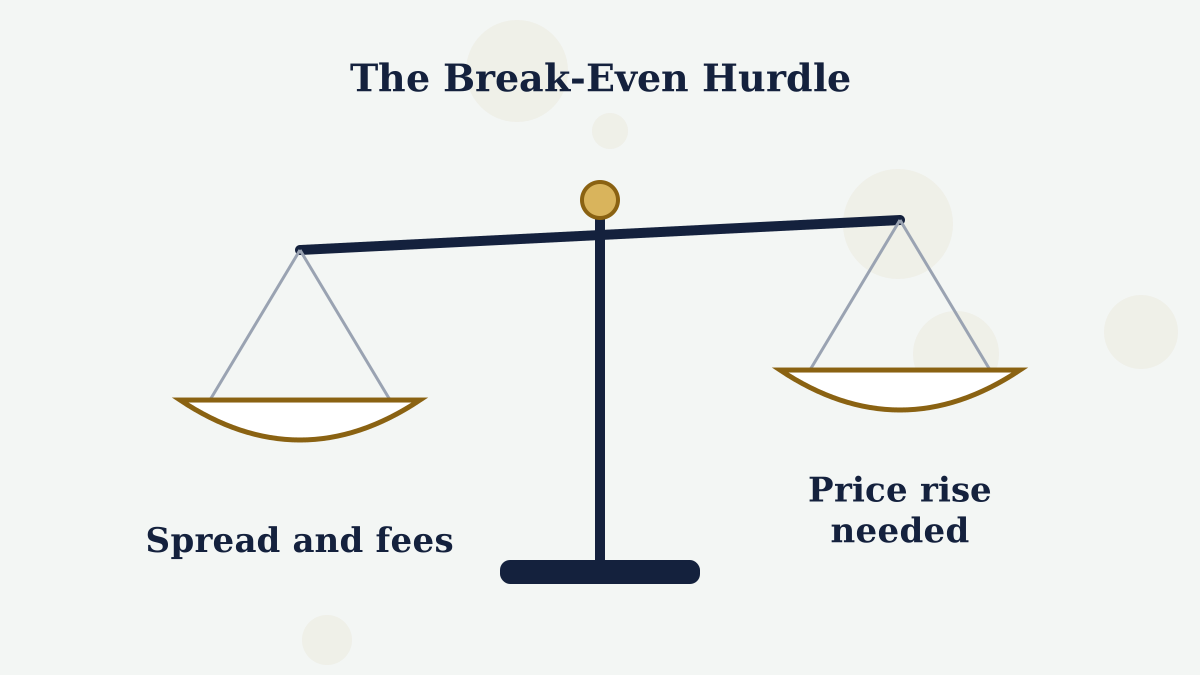
Here's an illustration of how costs set a hurdle. Assume a $50,000 purchase at 5% over spot, $285 a year in fees (Noble Gold's published total) and a dealer bid of 2% under spot when you sell.
| Holding Period | Fees Paid | Approximate Rise Needed to Break Even |
|---|---|---|
| 1 year | $285 | About 8% |
| 5 years | $1,425 | About 10% total |
| 10 years | $2,850 | About 13% total |
These are rough figures that ignore taxes and assume no further purchases. They show why buying common bullion at a fair spread and holding for the long term make such a difference.
How We'd Reduce the Risk
- Size It Sensibly
A modest share of savings, not your whole retirement.
- Pay a Fair Price
Common bullion, written quotes and one comparison quote.
- Choose Flat, Published Fees
Predictable costs that shrink as your account grows.
- Hold for the Long Term
Give gold time to work and let one-time costs spread out.
- Follow the Rules
Direct transfers, approved storage and eligible metals only.
Can You Lose Money in a Gold IRA FAQs
Can a gold IRA lose value?
Yes. The value of your gold IRA rises and falls with the price of the metal it holds. Gold reached about $5,608 an ounce in January 2026 and was near $4,000 by early November 2026.
Is my gold IRA safe if the dealer goes out of business?
The metal in a properly set-up gold IRA is owned by your IRA and held by an independent custodian and depository, not the dealer. That separation is designed to protect you if a dealer closes.
How long does it take to break even on a gold IRA?
It depends on the spread you paid and your yearly fees. If your purchase costs 5% over spot, gold has to rise more than 5% before you're back to even, before counting yearly fees.
Is a gold IRA safer than stocks?
Not in every period. Gold often behaves differently from stocks, which can help in a downturn, but it can also fall when stocks rise. Most planners treat it as a diversifier rather than a safe haven for all of your savings.
The Bottom Line
You can lose money in a gold IRA through price drops, overpaying, fees, badly timed sales and rule mistakes. The price risk is real and can't be removed, but the others are largely in your hands.
Working with a company that publishes its fees, sells common bullion and handles compliance takes care of much of it. That's why we point most readers to Noble Gold first.