A 401(k) is a workplace retirement plan you fund from your paycheck, often with an employer match, and it usually invests in a set menu of funds. A gold IRA is a self-directed IRA you open yourself that can hold physical gold and other precious metals.
They aren't really competitors. Most people keep contributing to their 401(k), especially to get the match, and use a gold IRA to hold part of their savings, often money rolled over from an old 401(k), in physical metal.
Gold IRA vs. 401(k) at a Glance
| Feature | Gold IRA | 401(k) |
|---|---|---|
| Who opens it | You, with a custodian | Your employer |
| What it holds | IRS-eligible gold, silver, platinum, palladium | A menu of funds chosen by the plan |
| 2026 contribution limit | $7,500, or $8,600 at 50+ (all IRAs combined) | $24,500, plus $8,000 catch-up at 50+ |
| Employer match | No | Often |
| Typical yearly costs | Custodian and storage fees, plus dealer spread | Fund expenses and plan fees |
| Funding | Contributions, rollovers, transfers | Payroll deductions |
| Withdrawals | IRA rules; RMDs from 73 for traditional | Plan and IRS rules; RMDs from 73 |
What Each Account Can Hold
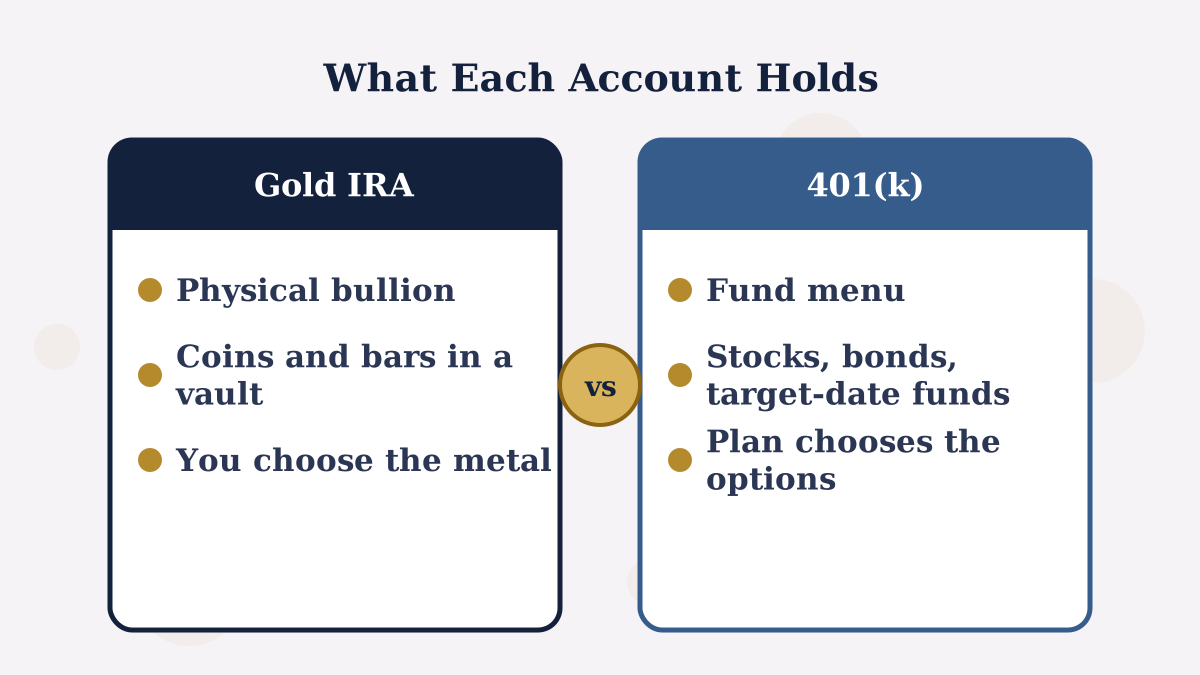
A 401(k) offers whatever your plan sponsor selects: typically stock and bond funds, target-date funds and sometimes a stable-value option. A few plans include a gold or commodity fund, but physical bullion is almost never available.
A gold IRA is self-directed, so it can hold IRS-eligible physical metal: gold at least 99.5% pure (with the American Gold Eagle exception), silver at 99.9%, and platinum and palladium at 99.95%. Our can you hold gold in a 401(k) guide explains the options inside workplace plans.
Contribution Limits and the Employer Match
The 401(k) has a much higher yearly limit: $24,500 in 2026, plus an $8,000 catch-up at 50 or older, with a higher catch-up for those aged 60 to 63. IRA limits are lower: $7,500, or $8,600 at 50 or older, across all your IRAs combined.
The 401(k) may also come with an employer match. That's one of the best returns available anywhere, so we'd rarely recommend cutting 401(k) contributions to fund a gold IRA.
The practical takeaway: most gold IRAs aren't built from yearly contributions. They're funded by rolling over money from an old 401(k) or moving money from an existing IRA, which isn't limited.
Costs Compared
A 401(k)'s costs come from fund expense ratios and plan administration fees, and they vary widely by employer. A gold IRA has a setup fee, flat yearly custodian and storage fees, and a dealer spread when you buy.
On a large balance, a flat-fee gold IRA can be competitive. Noble Gold, for example, publishes $285 a year in total yearly fees. On a small balance, the 401(k) is usually cheaper. See our gold IRA fees guide.
Access and Flexibility
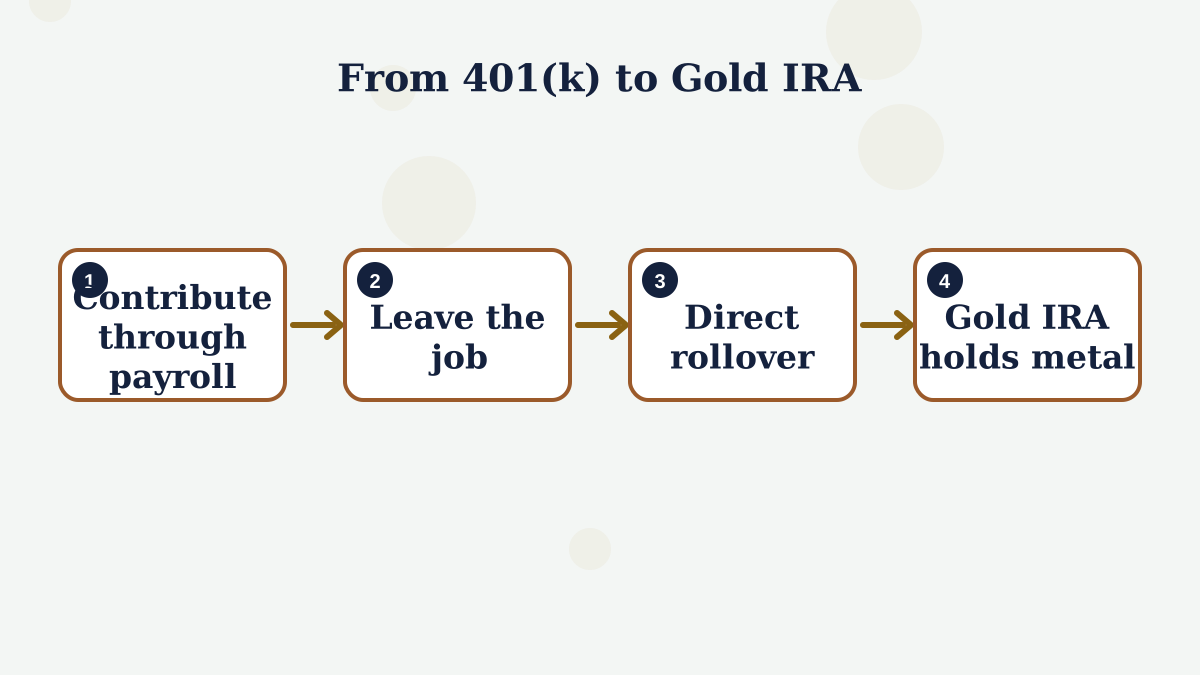
While you work for an employer, your 401(k) money usually stays in the plan, unless the plan allows in-service distributions, often from age 59½. Once you leave, you can roll the balance into an IRA, including a gold IRA.
A gold IRA gives you more control over what you own and who holds it. Selling metal takes a few days, but you choose the dealer, the products and the depository. Our in-service rollover guide explains the options while you're still employed.
Using Both Together
Keep Saving in the 401(k)
Payroll contributions and any match continue to build your savings.
Roll Old Plans Into a Gold IRA
When you leave a job, moving part of that 401(k) into a gold IRA adds physical metal.
Keep the Gold Share Modest
Many planners suggest a modest slice of total savings in precious metals.
Review Once a Year
Rebalance if gold drifts far from your target share.
Our 401(k) to gold IRA rollover guide walks through the move step by step.
Taxes on Each Account
Traditional 401(k)s and traditional gold IRAs are taxed the same way: contributions go in pre-tax, growth is tax-deferred and withdrawals are taxed as income. Both have RMDs from 73. Roth versions of each offer tax-free qualified withdrawals.
Moving money from a 401(k) to a gold IRA by direct rollover doesn't trigger tax, as long as the account types match. Our gold IRA rollover guide explains how to do it without withholding.
Gold IRA vs 401(k) FAQs
Is a gold IRA better than a 401(k)?
They do different jobs. A 401(k) is best for building savings through payroll contributions and any employer match. A gold IRA lets you hold part of your retirement money in physical metal. Many people use both.
Can I have a 401(k) and a gold IRA at the same time?
Yes. You can keep contributing to your workplace 401(k) and hold a separate gold IRA, funded by a rollover from an old plan or by IRA contributions within the yearly limit.
Can my 401(k) hold physical gold?
Almost never. Most 401(k) plans offer a fixed menu of funds. Some include gold funds, but physical bullion usually requires a self-directed IRA.
Should I stop contributing to my 401(k) to fund a gold IRA?
Usually not, especially if your employer matches contributions. The match is effectively free money. Many people fund a gold IRA with an old 401(k) or IRA instead.
The Bottom Line
A 401(k) is the engine of most people's retirement savings, especially with an employer match. A gold IRA is a way to hold part of those savings in physical metal. Used together, with a sensible allocation to gold, they complement each other.